
Conflict Watchlist 2022
Report
10 Conflicts to Worry About in 2022: Colombia | Mid-Year Update
The page discusses the widespread violence in Colombia amidst recent political changes and the challenges faced by President Gustavo Petro.

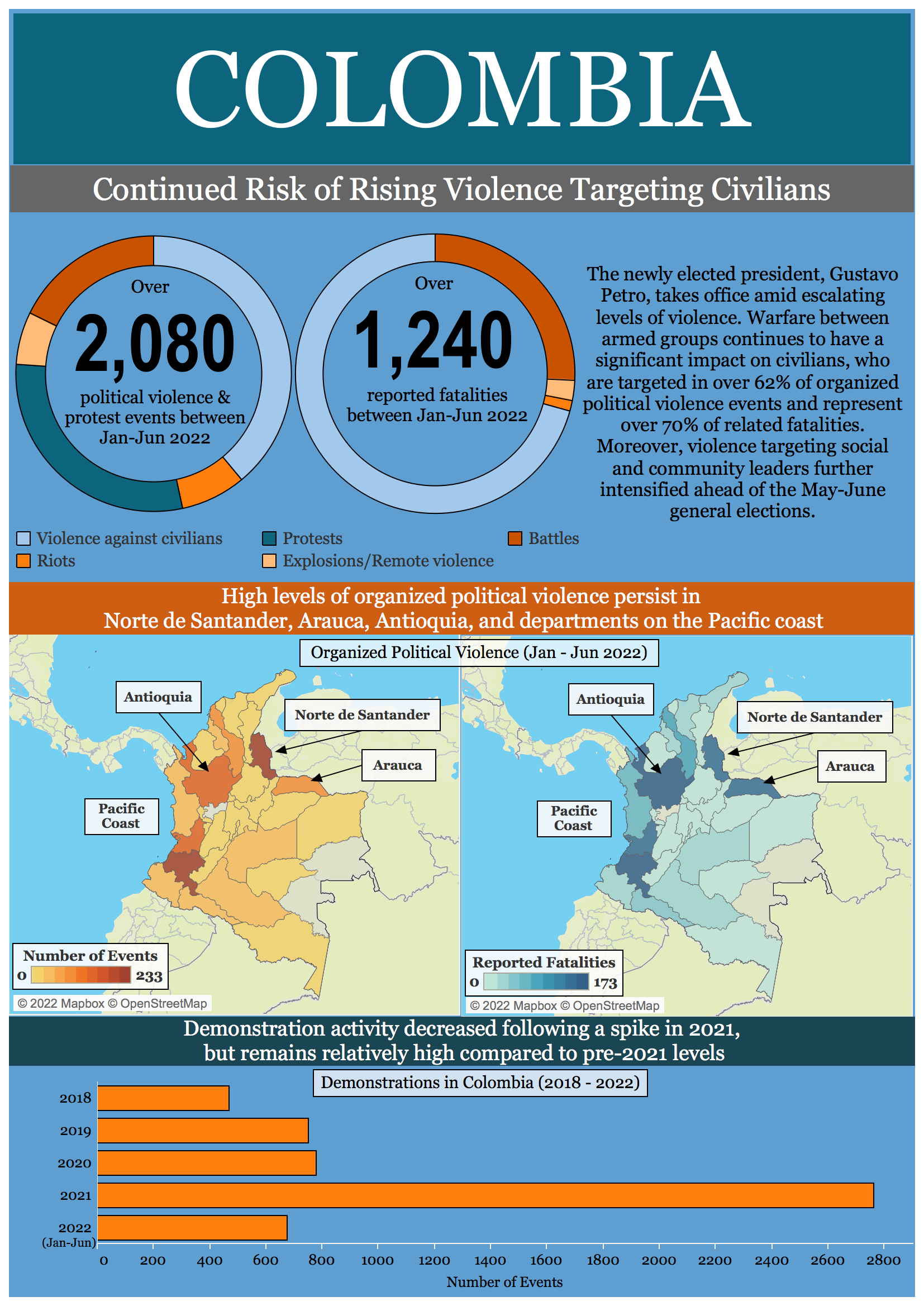
Continued Risk of Rising Violence Targeting Civilians
In June 2022, Colombia elected left-wing former guerrilla fighter Gustavo Petro to the presidency, marking a turning point for the country, which has been governed by moderate and conservative politicians for decades. The newly elected president faces significant security challenges, as he takes office amid high levels of violence: during the first half of 2022, over 1,300 organized political violence events were recorded across the country.
Violence intensified ahead of the May-June general elections. The Electoral Observation Mission qualified the 2022 electoral period as one of the most violent in the last decade (MOE, 2022). ACLED records a 19% increase in political violence events targeting politicians and social and community leaders in the lead-up to the elections from 1 January to 19 June 2022 (when the election was held), compared to the period leading up to the 2018 election, between 1 January to 17 June (when the election was held). In February and May, the National Liberation Army (ELN) and the Gulf Clan organized armed curfews to protest against President Iván Duque’s policies and the extradition of the Gulf Clan’s leader, Dairo Antonio Usuga, to the United States, respectively (Reuters, 21 February 2022; France 24, 7 May 2022). The strikes paralyzed several departments with roadblocks and the use of remote explosions while, on the sidelines of their operations, both armed groups attempted to influence the votes of local residents through intimidation (Insight Crime, 27 May 2022; Crisis Group, 24 May 2022). In Bolívar and Sucre departments, where the Gulf Clan maintains a heavy presence, incidents of violence targeting civilians doubled in the first half of 2022 compared to the entirety of 2021, with a peak recorded in May. The resurgence of violence in these departments comes with reports that the Gulf Clan issued voting orders and carried out targeted attacks on residents (El Tiempo, 11 January 2022), indicating that the group may feel emboldened to pose as a contender to state authority.
Experts attribute the rise in violence to President Duque’s failure to provide security guarantees and social and rural reforms laid out in the 2016 Peace Agreement (Colombia Report, 7 June 2022). Violent incidents between armed groups nearly doubled in 2021 compared to the year prior, and levels of armed clashes and remote violence remain high in the first half of 2022.
The Norte de Santander and Cauca departments continue to be epicenters of violence in Colombia, driven by armed actors competing for the exploitation of coca crops and key drug, weapon, and human trafficking routes along the border with Venezuela and the Pacific coast (ACAPS, 8 March 2022). Multiple armed actors are present in these areas, such as the ELN, dissident Revolutionary Armed Forces of Colombia (FARC) factions, the Gulf Clan, and other drug trafficking gangs.
Rivalries between armed groups in these regions have also translated into worsening violence in neighboring departments. In the first half of 2022, the number of violent incidents between armed groups in Chocó and Valle del Cauca has nearly equaled the number recorded in these departments during the entirety of 2021. Violence has already surpassed levels recorded in 2021 in Arauca, where dissident FARC factions have tried to gain control of key trafficking routes along the Venezuelan border (Latino América 21, 15 February 2022, RFI, 27 February 2022). More than 30 fatalities have been reported in Arauca in the first half of 2022 during intense fighting between dissident FARC factions and the ELN, which has predominantly controlled the area since the demobilization of the FARC in 2017 (ACAPS, 31 January 2022). Meanwhile, along the Pacific coast in Chocó, the turf war between the Gulf Clan and the ELN has continued to intensify following the Gulf Clan’s expansion into ELN-controlled territories in 2021 (Insight Crime, 27 April 2022). Further south, the Gulf Clan and the ELN have clashed in Valle del Cauca over control of the port in Buenaventura city (Insight Crime, 4 March 2021).
Conflict between armed groups continues to have a significant impact on civilians, with high levels of civilian targeting holding through the first half of 2022. Violence targeting civilians accounted for over 62% of all organized political violence events in Colombia and over 70% of related fatalities during this period. In Norte de Santander, civilians along both sides of the Colombian-Venezuelan border have faced increasing threats, displacing thousands (Insight Crime, 20 June 2022).
Social leaders and members of vulnerable groups remain the most exposed to violence, as they often coordinate support for the implementation of the peace agreement and advocate for land access in their communities (Crisis Group, 6 October 2020). Violence targeting social leaders is particularly acute in Arauca department, with levels in the first half of 2022 surpassing those recorded in the entirety of 2021. This represents a change in the dynamics of violence in Arauca, where armed clashes and attacks targeting oil infrastructure previously predominated.
To counter the hegemony of armed groups in local communities, state forces stepped up their operations in the first half of 2022, especially in Norte de Santander and Antioquia. Violent interactions between armed groups and state forces increased by nearly 30% relative to the same period in 2021, including explosions and remote violence incidents, which more than tripled.
The military operations have drawn criticism for their inability to tackle ongoing armed conflicts and for exposing civilians to additional violence, as they are often caught in the crossfire. Human rights organizations have additionally raised concerns that military forces are conducting extrajudicial killings and targeting Indigenous community leaders after the killing of 11 people in a raid against alleged guerillas in Putumayo (France 24, 31 March 2022).
Calls for increased protection of social leaders and vulnerable groups, and the implementation of the 2016 Peace Agreement, continue to drive demonstration activity across the country, particularly in April, on the one year anniversary of the 2021 uprising. Although demonstrations decreased by 68% in the first half of 2022 compared to the same time period in 2021, activity remained relatively high compared to pre-2021 levels. Demonstrators continue to voice discontent against insecurity and dysfunctional public services, as well as to call for labor rights.
Colombia’s security situation threatens to deteriorate further in the second half of 2022. Multiple reforms outlined in the Peace Agreement are yet to be fully implemented, and Duque’s militarized approach seems to have ultimately yielded limited results. The election of Petro, a former guerilla fighter critical of the ‘War on Drugs’ (Insight Crime, 21 June 2022), could lead to new security dynamics. The ELN and Gulf Clan have shown willingness to take part in peace negotiations, on the condition of initiating a series of reforms and pardoning fighters from legal proceedings (Insight Crime, 22 June 2022; EFE, 21 July 2022). While Petro has engaged in negotiations to secure a majority in congress (Bloomberg, 26 June 2022), the newly elected president may face opposition to his approach to the armed groups.
Related content


