

Conflict Watchlist 2022
Report
10 Conflicts to Worry About in 2022: Sudan
Sudan's political turmoil with military factions gaining power amid violence.
Mid-year update now published. Click here to read.
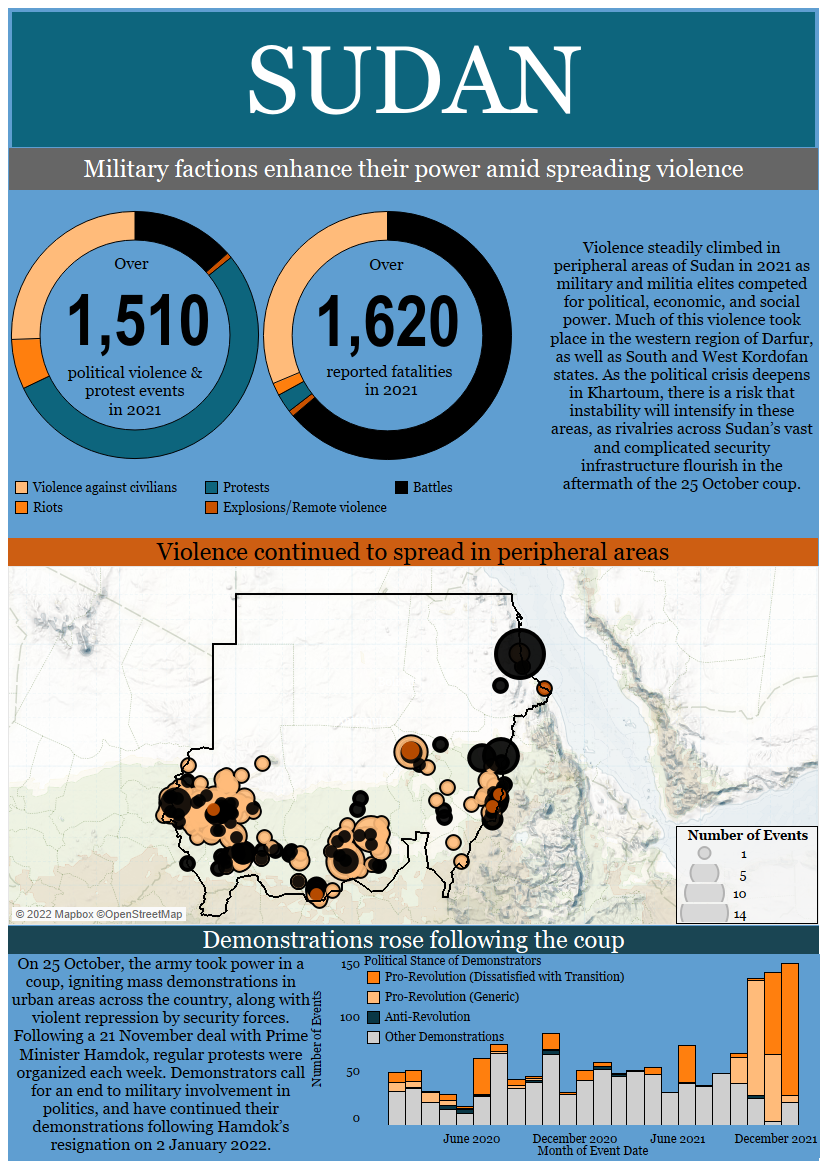
Military factions enhance their power amid spreading violence
The dubious narrative that Sudan was ‘transitioning to democracy’ became increasingly difficult to sustain in 2021, as the country’s contending military factions competed and colluded to secure political power and economic assets in the capital, Khartoum. This culminated in a military coup on 25 October 2021 which saw the arrest of the beleaguered civilian Prime Minister Abdalla Hamdok (for more, see ACLED’s report: Appetite for Destruction: The Military Counter-Revolution in Sudan), which ushered in weeks of unrest in urban areas across the country. Meanwhile, serious conflicts played out on the fringes of Sudanese territory, with provincial violence often reflecting the dynamics of confrontation and intimidation present in the capital (for context on the dynamics in the wake of the December 2018 uprising, please see ACLED’s report: Danse Macabre: Revolution and Counter-Revolution in Post-Oil Sudan).
On 21 November 2021, following weeks of demonstrations against the coup, and intensifying repression from military, paramilitary, and police forces (Human Rights Watch, 23 November 2021), Prime Minister Hamdok was reinstated into office. This followed an opaque negotiation with the military, which was seemingly brokered by a pro-establishment politician, Fadlallah Burma Nasir (Berridge, 2022). Hamdok now presided over a cabinet of military-approved ‘technocrats’ and JPA signatories who had backed the coup. Correctly sensing that the deal merely legitimized the military power grab, demonstrators swiftly turned against it (Alneel, 2021), with protests being organized each week in major towns and cities since the new deal was signed. Dozens of demonstrators have been killed and hundreds wounded by security forces and paramilitaries since the coup (Radio Dabanga, 9 January 2022; Radio Dabanga, 19 January 2022). Security forces have also been accused of engaging in sexual violence (Radio Dabanga, 23 December 2021a) and assaulting journalists (Radio Dabanga, 23 December 2021b). There is a high potential for Sudan’s vast and complex security apparatus to engage in escalating violence against demonstrators in the coming months, particularly if demonstrators continue to hurt the military bloc’s economic interests by shutting down critical transport corridors.
On 2 January 2022, Hamdok resigned from his position, reportedly due to the military bloc’s decision to extend the powers of the General Intelligence Service (the successor to the notorious National Intelligence and Security Service) and to block re-appointments of ambassadors who had been critical of the coup (Berridge, 2022). Since Hamdok’s resignation, the military has continued to unilaterally appoint officials to governing organs, while reviving links with select elements of the National Congress Party (the ruling party under ex-President Omar Bashir). Meanwhile, Resistance Committees and the Sudan Professionals Association1 have rejected a United Nations initiative to mediate between the civilian and military blocs, and continue to call for the military to be removed from politics altogether (Alneel, 2022; Africa Confidential, 12 January 2021). It remains to be seen whether these progressive political forces are able to successfully push for an alternate model for the Sudanese political economy. This is especially as the political economy has hitherto been dominated by an alliance of military officers and business elites who have violently extracted wealth from rural peripheries. Such a model would need to overcome long-standing rifts between urban and rural spheres, which have been exploited to perpetuate various forms of military rule, while somehow demilitarizing political and economic activity in both spheres (el Gizouli, 2021).
As these developments unfolded in the capital, violence continued to steadily climb in Sudan’s geographical peripheries as militias (often organized along ethnic or sub-ethnic lines) competed for political, economic, and social power. Much of this violence took place in the western region of Darfur, where predation and attacks loom over farming areas, towns (especially those hosting IDPs), and along roads connecting IDP settlements to these areas. West Darfur state in particular was the site of dramatic rounds of hybrid clashes and massacres. These often involve Arab-identifying (typically Rizeigat) militias — suspected of being backed by the Rapid Support Forces (RSF) paramilitaries — launching attacks on other ethnic groups near the border with Chad. In South and West Kordofan states (close to the border with South Sudan) the second half of 2021 was punctuated by frequent clashes among local militias. In North Kordofan state — which typically experiences significantly less violence than southern areas of the Kordofan region — over 30 were killed in fighting between the Katouil and Dar Hamid ethnic groups in West Bara locality on 17 November.
While the military bloc has retained good connections to most of Sudan’s neighbors, the deteriorating relationship between Sudan and Ethiopia has remained a cause for international and regional concern, with the conflict in Al Fashaga in eastern Gedaref state continuing to simmer. This is a disputed area, with control switching between Sudan and Ethiopia for over a century (for more, see ACLED’s report: Red Lines: Upheaval and Containment in the Horn of Africa). Although western areas of Al Fashaga remained in the hands of Sudanese farmers, eastern areas had been annexed by Ethiopian settlers and militias in the mid-1990s. Following skirmishes in late May 2020, the Sudan Armed Forces (SAF) and paramilitary ‘Reservists’ moved into the area in November 2020 as the war in the neighboring Tigray region of Ethiopia began. Within weeks, Sudanese forces were engaging in regular clashes with Ethiopian National Defence Forces, Amhara Liyu Police, and Amhara local militia, occasionally backed by Eritrean forces. Fighting – as well as attacks and abductions by Amhara militias targeting Sudanese shepherds – have been concentrated in the southern locality of Basundah since late May, while the border between Galabat and Metema towns was officially closed for the second half of the year. The successes of SAF in reclaiming much of the territory provided a political boost to Lieutenant General Abdel Fattah Al Burhan, the commander-in-chief of SAF and head of Sudan’s Sovereign Council.
After a quiet summer, Ethiopian forces launched fresh offensives in late September and late November, with the latter attack killing at least 21 Sudanese military personnel and prompting two days of shelling between SAF and Ethiopian forces. The unpopularity of the 25 October coup may well lead to Burhan intensifying Sudan’s involvement in the border conflict, which he had used to accrue political capital earlier in 2021. Yet recent overtures from Addis Ababa (Addis Standard, 6 January 2022), alongside initial steps towards a partial reopening of the border (Sudan Tribune, 6 January 2022; Sudan Tribune, 26 January 2022; Al Sudani, 11 January 2022), suggest that some form of agreement or accommodation could be reached on Al Fashaga.
Further Reading
Glossary
Glossary
- Demonstrations: This term is used to refer collectively to all events coded with event type protests, as well as all events coded with sub-event type violent demonstration under the riots event type.
- Disorder: This term is used to refer collectively to both political violence and demonstrations.
- Event: The fundamental unit of observation in ACLED is the event. Events involve designated actors – e.g. a named rebel group, a militia or state forces. They occur at a specific named location (identified by name and geographic coordinates) and on a specific day. ACLED currently codes for six types of events and 25 types of sub-events, both violent and non-violent.
- Political violence: This term is used to refer collectively to ACLED’s violence against civilians, battles, and explosions/remote violence event types, as well as the mob violence sub-event type of the riots event type. It excludes the protests event type. Political violence is defined as the use of force by a group with a political purpose or motivation.
- Organized political violence: This term is used to refer collectively to ACLED’s violence against civilians, battles, and explosions/remote violence event types. It excludes the protests and riots event types. Political violence is defined as the use of force by a group with a political purpose or motivation. Mob violence is not included here as it is spontaneous (not organized) in nature.
- Violence targeting civilians: This term is used to refer collectively to ACLED’s violence against civilians event type and the excessive force against protesters sub-event type of the protests event type, as well as specific explosions/remote violence events and riots events where civilians are directly targeted.
For more methodological information – including definitions for all event and sub-event types – please see the ACLED Codebook.
Footnotes
- 1
Resistance Committees are activist networks who have, alongside the Sudan Professionals Association (a trade union) played a leading role in opposing Bashir and contesting the subsequent attempts at consolidating military rule following the April 2019 coup.


