
Conflict Watchlist 2022
Report
10 Conflicts to Worry About in 2022: Yemen
A comprehensive analysis of the Yemen conflict in 2021 and future projections for 2022.
Mid-year update now published. Click here to read.
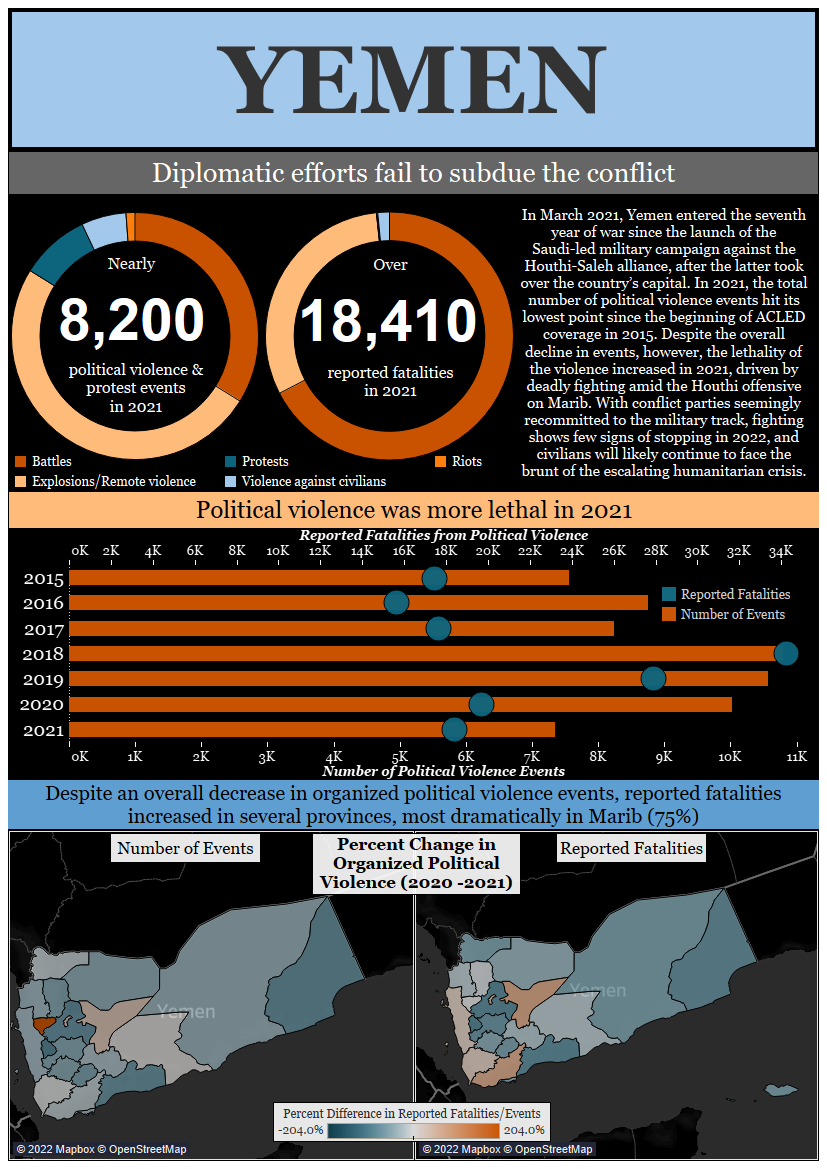
Diplomatic efforts fail to subdue the conflict
In March 2021, Yemen entered the seventh year of war since the launch of the Saudi-led military campaign against the Houthi-Saleh alliance, after the latter took over the country’s capital. The war in Yemen is multilayered and has resulted in the country’s deep fragmentation at all levels, leading some to conclude that “a unified Yemeni state no longer exists” (Arab Gulf State Institute in Washington, 8 October 2021). The internationally recognized president, Abdrabbuh Mansour Hadi, resides in Saudi Arabia, while the Houthis control Yemen’s capital, Sanaa. The temporary capital of the Hadi government, Aden, is in the hands of the secessionist Southern Transitional Council (STC).
On the ground, Houthi forces are fighting against a mix of military and tribal pro-Hadi forces in northern and central governorates, National Resistance Forces (NRF) on the western coast (for more on the NRF, see ACLED’s report: Who are the UAE-backed Forces Fighting on the Western Front in Yemen?), and forces affiliated with the STC in the southern governorates. In the south, control is split between Hadi and STC loyalists under the November 2019 Riyadh Agreement.1 While Islamist insurgencies, led by Al Qaeda in the Arabian Peninsula (AQAP) and the Yemeni branch of the Islamic State (IS), have also plagued the country, both groups appear considerably weakened today (for more, see ACLED’s report: Wartime Transformation of AQAP in Yemen).
Despite the country’s continued fragmentation, overall levels of political violence fell in 2021. ACLED records less political violence in Yemen in 2021 — fewer than 7,400 events — than in any year since the beginning of ACLED coverage in 2015. This sharp decrease in 2021 — a drop of 27% compared to 2020 — can be explained by the relative freezing of a number of fronts between Houthi and anti-Houthi forces. Battle events, for instance, decreased by 66% in Ad Dali governorate, 53% in Sadah governorate, and 49% in Al Jawf governorate between 2020 and 2021.
The overall decrease in political violence levels, however, belied the deadly state of conflict in 2021. Although reported fatalities decreased for the third consecutive year in 2021, the lethality of the conflict — the number of reported fatalities per event — increased sharply in 2021 compared to 2020. ACLED now estimates that more than 150,000 people have died as a direct result of the violence, including over 14,500 civilians killed in targeted attacks. In 2021, nearly half of all reported fatalities from political violence stemmed from the Houthi offensive on Marib, launched in February 2021. Political violence in the governorate increased by 34% between 2020 and 2021, with reported fatalities increasing by 75%.2
Between January and April 2021, Houthi forces advanced towards Marib city through the western districts of the governorate before their progress stalled for several months. This pause was partially due to an unprecedented engagement of international actors in support of the peace process, which saw renewed Houthi participation in negotiations (Middle East Eye, 10 June 2021). In May and June, political violence in the country dropped to its lowest levels since the Kuwait peace talks in May 2016. However, in another failure of the diplomatic track, Houthi forces renewed their offensive in late June and captured five districts in the south of Marib governorate to reach the outskirts of Marib city in December. This advance was made possible by prior gains in Al Bayda governorate and the northwestern districts of Shabwah governorate, which Houthi forces entered for the first time since 2017.
Further significant ground developments in 2021 took place in the western coast governorates of Taizz and Hodeidah. In March, pro-Hadi forces made their most significant gains of the year against Houthi forces in Jabal Habashy and Al Maafer districts in Taizz governorate. On the other hand, Houthi forces took over a 100-kilometer coastal strip in Hodeidah governorate in November, after the NRF withdrew from positions held since the signing of the Stockholm Agreement in December 2018.3 This resulted in a complete reshuffling of the frontlines in Hodeidah governorate, with the NRF shifting their focus onto inland areas along the Hodeidah-Taizz border, advancing into Maqbanah district in Taizz (for more on territorial changes, see ACLED’s project: Mapping Territorial Control in Yemen).
In the southern governorates,4 political violence decreased by almost 50% in 2021 compared to the previous year. This was driven mainly by a decrease of more than 75% in Abyan governorate, which was the result of the STC and Hadi government forming a power-sharing cabinet in December 2020 (Middle East Institute, 1 February 2021). Yet, both parties continued to work in isolation from each other, and the STC threatened to withdraw from the agreement in November (STC, 9 November 2021). The fragility of the situation in southern Yemen was further exacerbated in 2021 by worsening living conditions amidst an unprecedented currency crisis (Sanaa Center, 10 September 2021). This led to a wave of civil unrest in the second half of the year (ACAPS, 29 November 2021).
Further Reading
Further Reading
- The State of Yemen: Mapping Territorial Control in Yemen
- Little-Known Military Brigades and Armed Groups in Yemen: A Series
- The Myth of Stability: Fighting and Repression in Houthi-Controlled Territories
- The Wartime Transformation of AQAP in Yemen
- Yemen’s Fractured South: ACLED’s Three-Part Series
- Inside Ibb: A Hotbed of Infighting in Houthi-Controlled Yemen
- Yemen Snapshots: 2015-2019
- Yemen’s Urban Battlegrounds: Violence and Politics in Sana’a, Aden, Ta’izz and Hodeidah
- ACLED Methodology and Coding Decisions around the Yemen Civil War
Glossary
Glossary
- Demonstrations: This term is used to refer collectively to all events coded with event type protests, as well as all events coded with sub-event type violent demonstration under the riots event type.
- Disorder: This term is used to refer collectively to both political violence and demonstrations.
- Event: The fundamental unit of observation in ACLED is the event. Events involve designated actors – e.g. a named rebel group, a militia or state forces. They occur at a specific named location (identified by name and geographic coordinates) and on a specific day. ACLED currently codes for six types of events and 25 types of sub-events, both violent and non-violent.
- Political violence: This term is used to refer collectively to ACLED’s violence against civilians, battles, and explosions/remote violence event types, as well as the mob violence sub-event type of the riots event type. It excludes the protests event type. Political violence is defined as the use of force by a group with a political purpose or motivation.
- Organized political violence: This term is used to refer collectively to ACLED’s violence against civilians, battles, and explosions/remote violence event types. It excludes the protests and riots event types. Political violence is defined as the use of force by a group with a political purpose or motivation. Mob violence is not included here as it is spontaneous (not organized) in nature.
- Violence targeting civilians: This term is used to refer collectively to ACLED’s violence against civilians event type and the excessive force against protesters sub-event type of the protests event type, as well as specific explosions/remote violence events and riots events where civilians are directly targeted.
For more methodological information – including definitions for all event and sub-event types – please see the ACLED Codebook.
Footnotes
- 1
The Riyadh Agreement was signed in November 2019 under the auspices of Saudi Arabia to resolve the conflict between the Hadi government and the STC after intense clashes erupted between the two camps in August 2019 (ACLED, 18 December 2019).
- 2
ACLED Methodology and Coding Decisions around the Yemen Civil War
- 3
In December 2018, the UN brokered the Stockholm Agreement to stop an offensive against Houthi forces along the west coast, fearing the humanitarian consequences of a battle for Hodeidah city. The agreement included a ceasefire throughout the governorate and the demilitarization of Hodeidah city.
- 4
Understood for data analysis purposes as Abyan, Aden, Al Mahrah, Hadramawt, Lahij, Shabwah, and Suqutra.


