
Brief
Mapping the 25 August Israel and Hezbollah attacks | ACLED Insight
Intense exchanges occurred between Israel and Hezbollah on 25 August 2024, featuring major airstrikes and rocket launches.
On 25 August 2024, Israel and Hezbollah engaged in one of the most intense exchanges of fire since October 2023. Early that morning, more than 100 Israel Defense Forces (IDF) jets launched airstrikes on approximately 40 locations in southern Lebanon. The Israeli military said it had targeted hundreds of rocket launchers to thwart what it described as an imminent large-scale attack by Hezbollah,1 which has been anticipated since 30 July after Israel claimed responsibility for the assassination of senior Hezbollah commander Fuad Shukr.
Hezbollah nevertheless launched hundreds of rockets and deployed drones against Israel shortly thereafter. The group claimed to have successfully targeted 11 military bases in northern Israel and the occupied Golan Heights, as well as an intelligence unit in central Israel. However, the reality on the ground is unclear as Israel issued a gag order banning reporting on damages caused to military bases.2 The IDF stated that none of its bases were “damaged” in the attack.3 The Iron Dome, Israel’s air defense system, intercepted the majority of Hezbollah’s projectiles, while others landed in open areas.4 ACLED records less than a handful of reported direct hits (see maps below). One Israeli soldier, two Hezbollah fighters, and a Hezbollah-allied member of the Amal Movement were killed during Sunday’s hostilities.
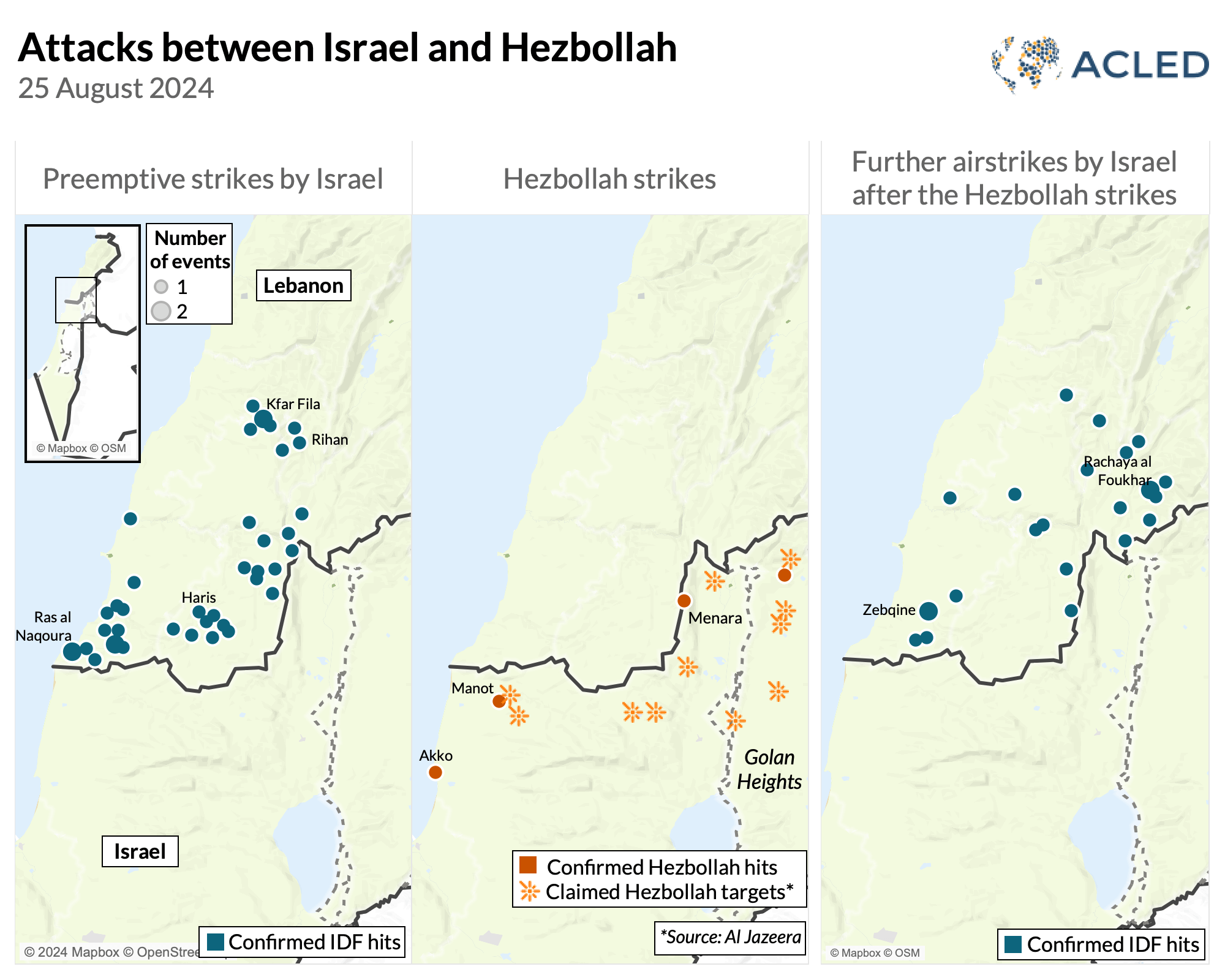
Despite the heavy exchanges, both sides still seem intent on avoiding a full-scale war, and the much-feared larger and more intense escalation was averted for the time being. While Israel’s preemptive strike likely prevented a large part of Hezbollah’s planned retaliation, the Lebanese group did not attempt to target civilians or use new tactics and weaponry, including precision missiles that could have triggered a much harsher Israeli retaliation. The hostilities, however, continue to simmer as it is still unclear if and when Iran will retaliate for the assassination of Hamas leader Ismail Haniyeh, and the prospects for reaching a ceasefire in Gaza remain uncertain.
Correction: An earlier version of the map omitted the source for the locations of hits claimed by Hezbollah that were not yet available in the ACLED dataset. The information was from Al Jazeera.
Correction 2: An earlier version of the map placed the location labels per second administrative zone. The labels now reflect the city level.
Visuals produced by Ciro Murillo.


