
Election Watch
Report
Mexico’s land and elections feuds threaten political figures in Oaxaca and Chiapas
This report examines how conflicts over land and competition between communities can fuel violence against political figures, particularly during election cycles.

This is the third report in ACLED’s Mexico Special Election Series and focuses on the southern states of Chiapas and Oaxaca.
It is not common to see masked men stop presidential candidates at makeshift checkpoints to deliver a message. But that is what happened to Claudia Sheinbaum, the presidential candidate for the ruling National Regeneration Movement party (MORENA), in Chiapas on 21 April. While driving through the state, Sheinbaum was stopped by a group of men in the Motozintla municipality who asked her “to remember these mountains, the poor people, when you’re in power”1 and address increasing insecurity.2 While the men did not identify themselves as part of a group, residents reported that checkpoints in the area are often set by members of the Sinaloa cartel. Sheinbaum discounted the claims that criminal groups were involved in the incident, likely aiming to downplay the reach of organized crime in Mexico — a common practice among the current government.3
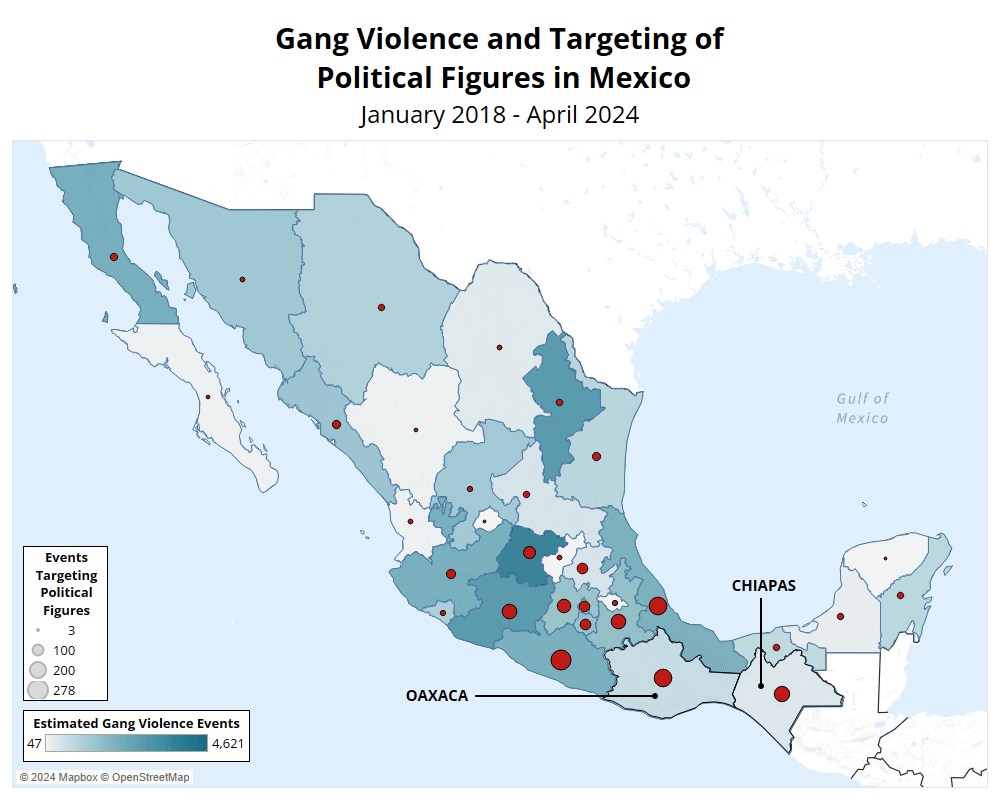
This event illustrates the extent to which political figures at all levels are exposed to acts of intimidation, if not outright violence, in southern Mexico. In fact, Oaxaca and Chiapas states record the second- and fourth-highest levels of violence targeting political figures, respectively, in the past six years (see map below). Following similar trends in other states, the risk for political figures tends to increase around electoral periods. However, the drivers of this type of violence differ from cases like Guanajuato, Michoacán, and Guerrero, states that are affected by active criminal turf wars, or states with hybrid intersections of political and criminal violence such as Veracruz, Puebla, and Mexico. By contrast, Oaxaca and Chiapas are not traditional hotspots of criminal activity and record lower levels of gang violence than the aforementioned states, although the recent outbreak of a dispute between the Sinaloa cartel and the Jalisco New Generation Cartel (CJNG) in Chiapas is starting to revert this trend. Against this backdrop, examining the local politics’ dynamics and specific drivers of conflicts is vital for understanding the roots of violence targeting political figures in these states.
Oaxaca and Chiapas have the largest share of Indigenous populations across the country. More than 10 ethnic groups are present in each state and make up 39% and 26% of the two states’ inhabitants, respectively. This demography has led to political decisions to use traditional forms of political participation and adopt conceptions of property rights that allow these communities to maintain their autonomy. However, the definitions of land rights and land uses have often triggered disputes between communities that, in some cases, have led to armed confrontations between communal militias or outbreaks of violence by mobs. The tensions that arise from operational differences between traditional Indigenous institutions and state-led ones can, at times, contribute to competition in these states turning violent.
This third part of ACLED’s Mexico Special Election Series explores how land conflicts and competition between communities are behind much of the violence against political figures in Chiapas and Oaxaca. The analysis identifies mob violence and violent demonstrations as some of the main forms of violence during election cycles. This partly stems from local leaders’ tactics to intimidate opponents or reject electoral results but is also linked to local communities’ established habits of taking justice into their own hands, even to hold elected officials accountable for misbehavior or failures to comply with electoral promises. Finally, the report illustrates criminal groups’ involvement in attacks targeting politicians and local leaders and determines that this has been exacerbated since 2023 in Chiapas as conflicts between cartels have broken out.
Land conflicts, politics, and elections
According to the Strategic Program of the National Agrarian Register for 2021 to 2024, there are around 500 unresolved land conflicts in Mexico, around half of which involve Indigenous communities in Oaxaca and Chiapas.4 Most often, these conflicts stem from long-standing disputes over the delineation of borders between municipalities and control over the administration of resources.5 The intervention of nonlocal actors — such as federal authorities or the private sector — fuels tensions as these parties seek to use the land and resources in Indigenous territories for mining and agriculture. Their involvement further undermines Indigenous groups’ autonomy and causes environmental and social damage.6 In some cases, these conflicts have turned violent, leading to the formation of communal armed Indigenous groups and self-defense groups. In other cases, they have led to targeted violence against leaders and politicians who stand against the exploitation of natural resources.
In Chiapas, land claims and the vindication of Indigenous rights have led to the emergence of communal militias and self-defense groups, including the Zapatista Army of National Liberation (EZLN), an insurgency movement born in 1994.7 In this state, violence involving communal militias represents at least 20% of the overall violence recorded since ACLED began covering Mexico in 2018 amid clashes between militias and attacks against residents of rival communities.
As political rivals seek to control the administration of land and its resources, this competition has contributed to reigniting tensions and communal conflicts, as well as intensifying actions of communal militias. This held particularly true during the 2021 electoral period in Chiapas (see graph below). That year, for example, conflict over the control of 60 hectares of agrarian lands between the communities of Aldama and Chenalhó municipalities contributed to a general rise in violence in the months before the elections. While the conflict has lasted for over 45 years,8 in March 2021, an incursion led by the community of Santa Martha in Chenalhó against neighboring communities in Aldama reignited the dispute, with violence spilling over to the 2021 local elections. This incursion came after the authorities of Aldama and Chenalhó signed an agreement in November 2020 that redistributed the lands between the two municipalities. The agreement gave more than half of the hectares claimed by Chenalhó to Aldama.9 Days after it was signed, armed militias from Chenalhó attacked a government official from Aldama.10
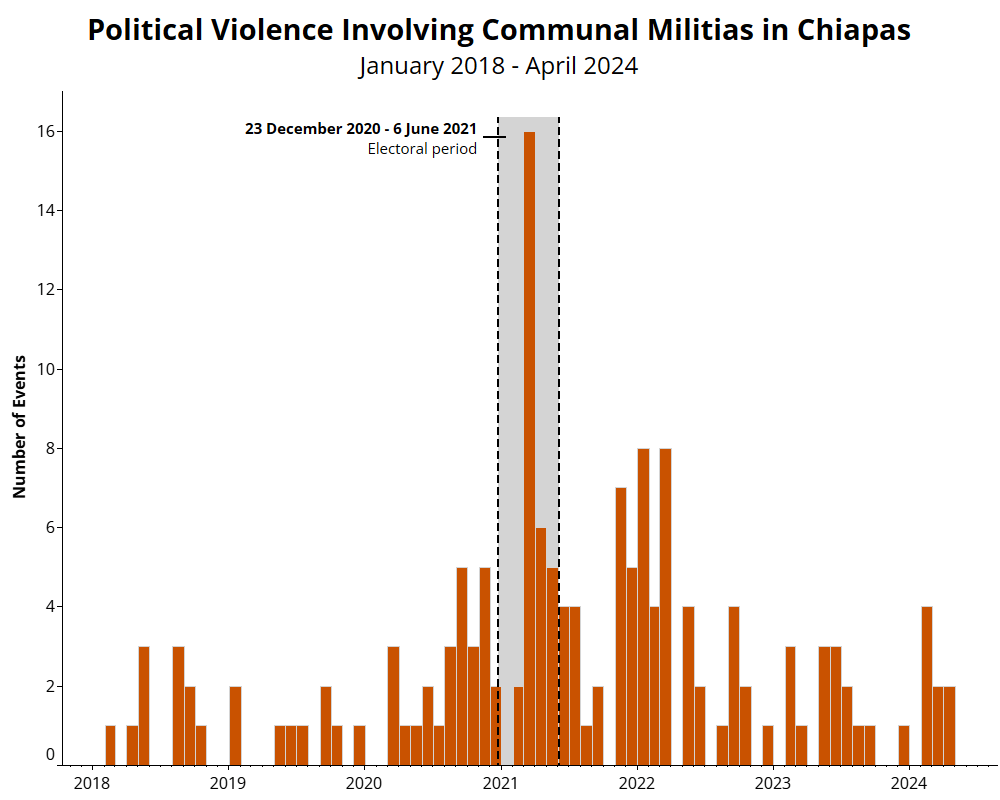
Though the conflict centers on communal control over land, political rivalries also fueled the violence. Local organizations have reported alleged links between communal militias and politicians from Chenalhó affiliated with the Ecologist Green Party of Mexico (PVEM), in power since 2016.11 In June 2021, militias from Chenalhó targeted voters in Aldama. Such violence has, in turn, affected the conduct of elections in the state. During the June 2021 elections, ongoing violence prevented the National Electoral Institute from installing more than 180 voting centers in six municipalities.12
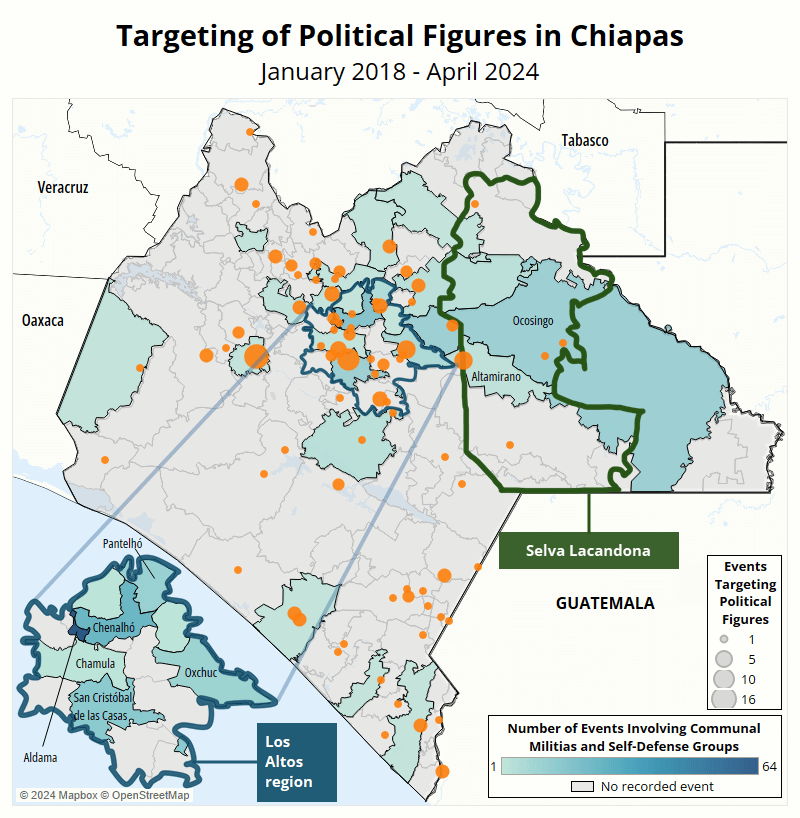
At the same time, these inter-communal conflicts also correlate with higher levels of violence targeting political figures. This link suggests that the presence of local militias may represent a key driver of such violence. Since 2018, the majority of the violent activity involving communal militias and self-defense groups has taken place in Los Altos region, which includes the municipalities of Aldama, Pantelhó, Chenalhó, San Cristóbal de las Casas, Oxchuc, and Chamula, among others. ACLED also records communal violence in Ocosingo and Altamirano municipalities, located in Selva Lacandona region — an EZLN stronghold. These areas are also home to a significant number of targeted attacks against political figures (see map below). While the perpetrators remain unknown in many cases, this trend is indicative of the likely involvement of communal militias in attacks against political figures.
In Oaxaca, ACLED also records a number of violent events linked to inter-communal territorial disputes. However, the involvement of militias is much less prevalent, representing only 6% of the violence in this state. Yet local politicians seeking to control state resources have fueled communal divisions and tensions. In Santiago Juxtlahuaca, a municipality in the west of Oaxaca, political divisions during the 2018 local elections led to an escalation of the conflict in the Tierra Blanca Triqui Indigenous community between the Movement of Triqui Unification and Struggle (MULT) and the similarly named Independent Movement of Triqui Unification and Struggle (MULTI) which had been going on since 2006. The rift deepened when the MORENA candidate, backed by MULT, won against the candidate of the Institutional Revolutionary Party (PRI), supported by rival MULTI. Violence escalated in 2020 and 2021 when MULT members forced MULTI members out of the community, allegedly in collusion with local authorities.13 Meanwhile, the MORENA mayor eventually left the mayorship in 2021 amid accusations of mismanaging federal resources for Indigenous communities and holding links with armed groups to intimidate opponents during his administration.14
Besides the inter-communal conflicts, political figures have taken part in land conflicts in which they seek access to the resources invested in infrastructure and extractive projects. At the same time, cases such as the killing of Felix Vicente Cruz in April 2023 — a municipal official who advocated for the protection of Indigenous land in Istmo region — show how political officials have also been targeted when they oppose these projects. The development of hydroelectric projects in Costa region and infrastructure projects in Istmo region has stoked tensions. One of the main projects of the current federal administration is the Interoceanic Corridor of the Isthmus of Tehuantepec (CIIT), which is expected to connect and develop industrial areas in Oaxaca and Veracruz states. The CIIT comprises 46 municipalities in Oaxaca; since 2018, ACLED has recorded violent actions against political figures in over 20 of these municipalities. Similar dynamics take place in the municipalities around Río Verde in Costa region, where the federal government has approved several hydroelectric projects.
In turn, local communities have long denounced land dispossession by the state and criminal groups, as well as environmental damages in Indigenous territories.15 By the end of 2022, the federal secretary of public security had opened more than 1,400 investigations for alleged dispossession of land and properties in which government officers were involved.16 Moreover, local politicians allied with armed groups have targeted Indigenous leaders, land defenders, and political figures who have opposed these projects or denounced the mismanagement of resources.17
Mob violence, looting, and property destruction events targeting political figures
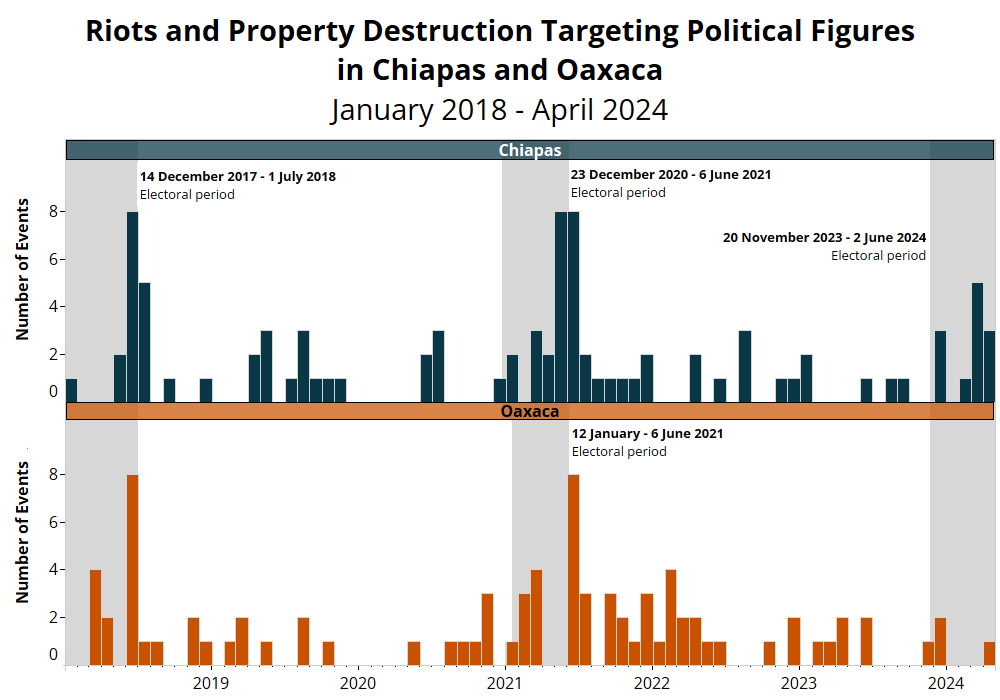
Although most of the violence targeting political figures consists of direct attacks, violence occurring in the context of riots and instances of property destruction is also very frequent in Chiapas and Oaxaca. This trend is not unique to these two states but is certainly more pronounced. Moreover, it reflects a deeply rooted practice wherein local communities express their grievances or take justice into their own hands without necessarily resorting to deadly violence.18 Communities have targeted political figures during riots, often through the temporary detentions of civil servants, as a tool to hold elected officials accountable. The perpetrators of such violence accuse political figures of failing to comply with certain campaign promises, corruption, vote buying, and clientelistic practices that often characterize local politics in southern Mexico dominated by leaders, also known as caciques.19
These practices occur throughout the years but, much like inter-communal violence, tend to peak around the elections (see graph below). In fact, besides communal grievances, local power struggles and electoral disputes between groups affiliated with a local political contender or a cacique are likely among the main drivers of mob violence, violent demonstrations, and property destruction. These can manifest in acts of intimidation, such as the targeting of parties’ premises or candidates’ houses in order to discourage participation; vandalism acts on polling stations and ballot boxes; unlawful occupation of municipal buildings; and clashes between supporters of opposing parties.
For example, opponents of Roberto Pinto Kanter, the mayor of Altamirano, Chiapas, from 2013 to 2021, accused him of nepotism.20 When his wife won the 2021 elections, mobs prevented her from taking office and eventually held Pinto Kanter captive for three weeks to force her to resign and form a new municipal council. Since then, this political dispute has prompted several violent events. In September 2023, a group of people associated with Pinto Kanter burned at least 43 houses, vehicles, businesses, and other properties belonging to members of the municipal council.21
In a context where local leaders and caciques rely on violent mobs for political purposes, traditional electoral systems such as usos y costumbres can be vulnerable to the emergence of violent power struggles. In this form of direct democracy, which reflects Indigenous traditions, authorities are elected by the whole community, often by a show of hands. Although research on this mechanism demonstrates its effectiveness in defusing certain local conflicts, it nevertheless remains subject to less oversight from state authorities and legal mechanisms to resolve election-related disputes.22 In March 2023, Oaxaca’s electoral authority dismissed the complaints of irregularities in the reelection of the mayor Rigoberto Vásquez in the municipality of Santiago Yaitepec, Oaxaca. However, this did not prevent the death of one person in a brawl between pro- and anti-mayor mobs; the latter opposed Vásquez’s reelection and denounced alleged cases of corruption.23
The municipality of Oxchuc, Chiapas, has also been governed by the usos y costumbres system since 2019. In December 2021, an election dispute led to severe violence when candidate Hugo Gómez Sántiz contested the Communal Electoral Organ’s decision to declare Enrique Gómez López the winner and proclaimed himself as the new mayor. This sparked violent confrontations between some of the two candidates’ supporters, who set up roadblocks and set more than 10 houses on fire. As a result, the Chiapas State Congress was forced to appoint an interim municipal council, not once but twice. The first council was blocked from assuming office, and the second is still in place today. These examples illustrate that the root of the violence often lies in cacicazgos‘ desire to seize power and ensure succession by lineage — which also happens in municipalities using the federal election system.
The looming shadow of growing organized crime
Violent activities of organized crime groups also intersect with communal disputes and political competition, fueling violence targeting politicians. In Oaxaca, gang violence is concentrated in strategic corridors for drug and migrant trafficking, as well as in the major cities where criminal groups control local drug markets and extortion. Such is the case in the city of Oaxaca and the municipalities that connect it to the Pacific coast through the main federal roads (see map below). Similarly, gangs have focused their violent actions in municipalities along Oaxaca’s borders with Veracruz, Puebla, and Guerrero states.24 This is most notable in the municipalities of Papaloapan region, where the CJNG has expanded its dominance of drug markets and routes that connect directly to Veracruz.25 The actions of criminal groups in these areas have also contributed to attacks targeting political figures as gangs seek to intimidate politicians into favoring their interests or prevent those who are against them from gaining power.26
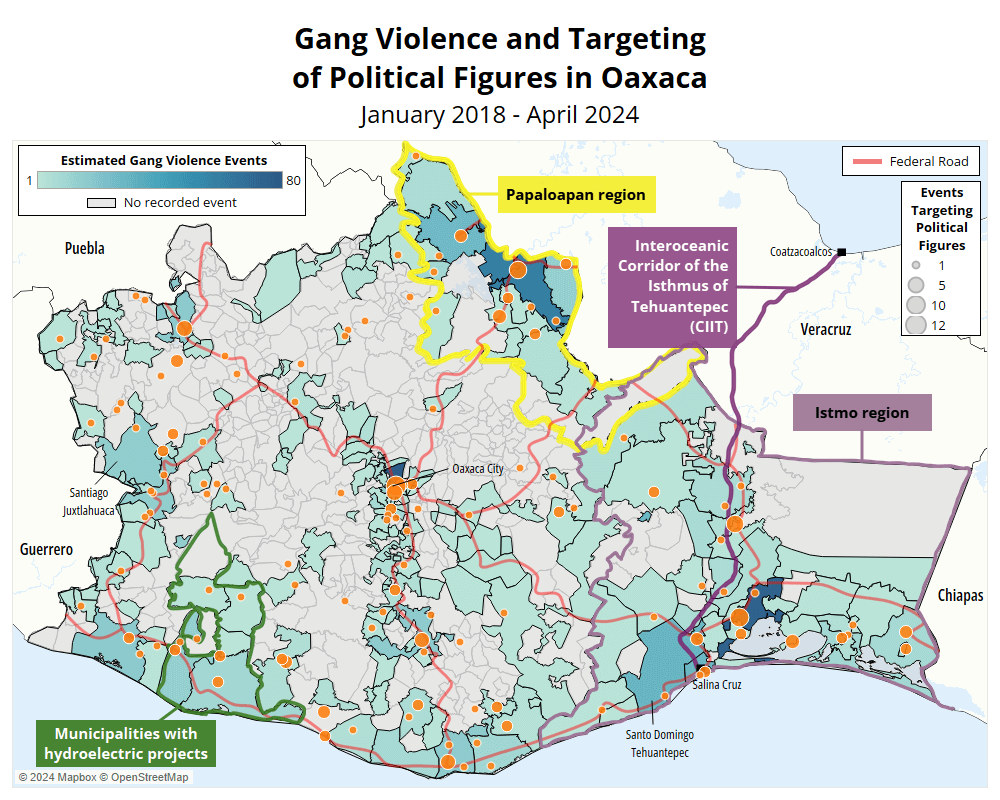
Additionally, criminal interests have increased in Istmo and the municipalities that are part of the CIIT project, particularly in the main cities of Juchitán de Zaragoza and Santo Domingo Tehuantepec, as well as the harbor city of Salina Cruz. These areas are located in strategic corridors for trafficking activities but also benefit from the economic development of the zone through extortion and corruption rings.27 Criminal groups are notably involved in land and property dispossession schemes to sell property at a high value in collusion with local authorities.28 In one such case, ACLED records the killing of at least four judicial officers and public servants trying to investigate local authorities and criminal groups involved in the criminal scheme known as the ‘Dispossession Cartel.’29 Also, CJNG is suspected of having links with local representatives in Istmo and threatening political figures who implement security measures affecting their activities.30
Meanwhile, in Chiapas, criminal groups’ operations also affect land and political conflicts amid a general increase in gang violence since 2021 (see graph below). This is especially true in Los Altos region and since the outbreak of the turf war between the CJNG and the Sinaloa Cartel on the southern border with Guatemala in 2023. In this state, criminal interests have revolved around the control of local resources, extortions, and drug and migrant trafficking routes.31 In response to the increase in gang violence, self-defense groups have emerged in some areas, including Pantelhó municipality, where in 2021, the self-defense group El Machete was born to fight criminal groups.32 El Machete has directly targeted local officials who have links with the former mayor and former municipal judge Austreberto Herrera, who was arrested in connection with numerous crimes in 2019.33 In June 2021, El Machete vandalized several local council members’ houses and allegedly kidnapped 21 people, while later they prevented the mayor-elect, Raquel Trujillo, from taking office.34
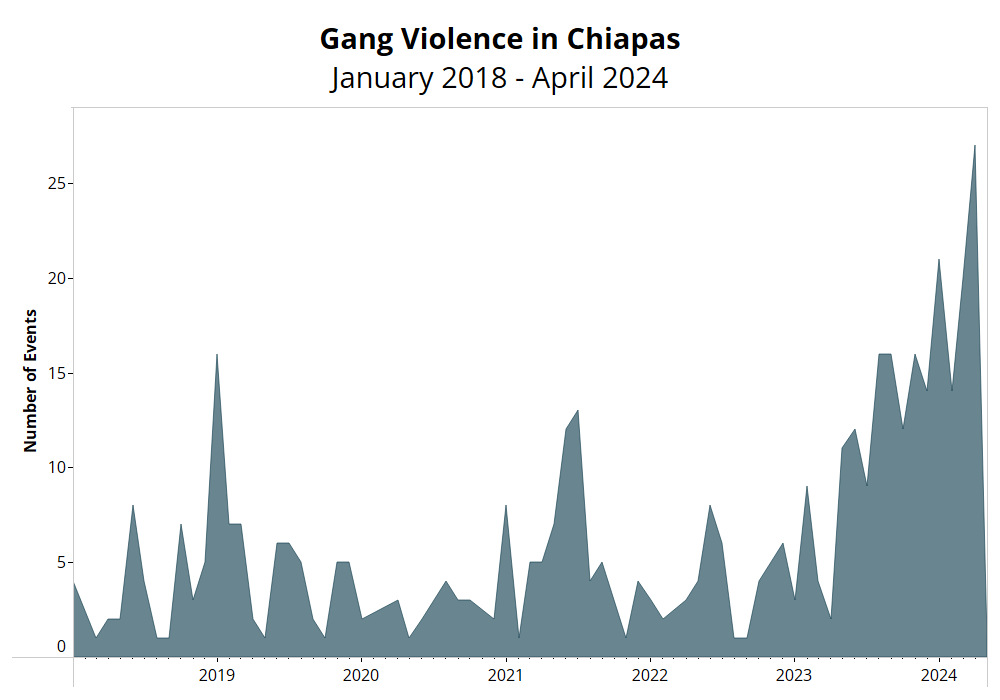
Since 2023, the incursion of CJNG in areas traditionally controlled by the Sinaloa Cartel has triggered an escalation of violence.35 As a result of this turf war, events of organized criminal violence tripled between 2022 and 2023, contributing to a 70% increase in overall political violence in the state. Violent actions and roadblocks involving these groups have been recorded along the southern border with Guatemala — strategic for illegal trafficking — and around Chicomuselo municipality to control mining activities. Communities in these municipalities have denounced the increasing pressure by cartel members to support their activities.36 Notably, the representatives of communities in Chicomuselo who have traditionally opposed mining activities by private companies have been forced by the CJNG’s allied local militia, El Maiz, to allow and participate in exploiting barite mines.37 The intensification of criminal wars is supposing one of the main risks for political figures ahead of the upcoming 2024 elections.
2024 elections: Risks for political figures mount in Chiapas
Ahead of and in the aftermath of the 2 June election, the continuation of land conflicts and competition between organized crime groups remain the main factors that elevate the risk of violence for political figures in Chiapas and Oaxaca. Chiapas, in particular, is likely set to experience one of its most violent electoral processes as the emergence of local militias and self-defense groups continues to exacerbate communal conflicts while the turf war between CJNG and the Sinaloa cartel keeps escalating. As a result, just between January and April 2024, ACLED records 21 events targeting political figures — six more than the total events recorded in 2023. By contrast, Oaxaca’s state authorities’ efforts to address the conflicts that triggered violence around past electoral processes seem to have yielded some successes. The state recorded five events in the first four months of 2024, much fewer than the 20 in 2018 and 15 in 2021.
The worsening security situation in Chiapas puts at risk the very ability to hold elections in certain parts of the state. This holds true for Los Altos region, where disputes between the El Machete self-defense group and other militias that have emerged to fight criminal groups have called for the cancellation of the election. Eighty-six Indigenous communities of Pantelhó refused to participate in this electoral process and elected their local council through the usos y costumbres system, fearing that the elections could fuel tensions and worsen the security situation.38 Despite the efforts by the National Electoral Institute (INE) to negotiate permission to hold the elections through the state-led party system, the Indigenous communities continue denying access to the electoral institution.39
Additionally, the war between CJNG and the Sinaloa Cartel is another factor that has deepened the security crisis, affecting the conditions for the elections, particularly in the southwestern Frontera and Sierra regions. In the context of this violent dispute, ACLED records attacks in the southern municipalities of Suchiate and Amatenango de la Frontera, where a mayoral candidate was killed and a state senator candidate was injured, respectively. Moreover, deadly clashes recorded around Chicomuselo municipality in 2024 have prompted the displacement of several communities.40 Against this backdrop, representatives of the Catholic Church and opposition members claim that the lack of security conditions precludes holding the vote in some areas of the state.41 Nonetheless, President Andrés Manuel López Obrador has reassured that the federal authorities and the INE will coordinate actions to guarantee security during the electoral process.42 However, even if authorities were effectively able to ensure minimum levels of security to hold the elections, the conflict between CJNG and the Sinaloa Cartel is likely to continue even after the polls, fueling the targeting of political figures, particularly in disputed areas.
For its part, although Oaxaca has made progress in addressing some of the conflicts driving violence targeting political figures, many remain active and run the risk of fueling violence around and after the elections. State authorities have sought to increase security and address social conflicts in at least 69 priority municipalities based on the high levels of violence recorded during the 2021 election. However, of these prioritized municipalities, they reckon that at least 37 are still at high risk of violence around the election.43Furthermore, around 270 land conflicts remain active in the state and are likely to keep fueling violence targeting political figures in the years to come.44This is particularly true for areas affected by infrastructure projects, such as the hydroelectric ones in Costa region and the CIIT in Istmo region. The killing of a land defender who opposed electricity megaprojects and was reportedly running for councilor for the Popular Unity Party in Santiago Jamiltepec, Costa region,45attests to the risks political figures continue to face in the state.
ACLED researchers María Alejandra Pérez and Natalie Tines supported the lead authors and contributed to this report with desk research.
Visuals were produced by Ana Marco.
Footnotes
- 1
- 2
- 3
- 4
- 5
- 6
- 7
- 8
- 9
- 10
- 11
- 12
- 13
- 14
- 15
- 16
- 17
- 18
- 19
- 20
- 21
- 22
- 23
- 24
- 25
- 26
- 27
Arena Pública, ‘Crimen organizado retrasa hasta 15 meses Corredor Transístmico,’ 13 February 2022
- 28
- 29
Jonathan Nácar, ‘El cártel del despojo: exgobernadores bajo sospecha,’ Eje Central, 24 March 2023
- 30
- 31
- 32
- 33
- 34
- 35
- 36
La Jornada, ‘Frontera Comalapa, en Chiapas, bajo violento control del ‘CJNG-El Maíz’, 29 May 2023
- 37
- 38
- 39
Milenio, ‘Violencia amenaza derecho al voto en Pantelhó, Chiapas,’ 15 May 2024
- 40
- 41
- 42
- 43
- 44
- 45
Related content


