Expert Comment
Palestine: Violence around aid distribution in Gaza surges as Israel’s campaign continues despite the Israel-Iran escalation — Expert Comment
ACLED's expert comments on the ongoing violence around aid distribution in Gaza amid the Israel-Iran conflict.

ACLED data show that, for now, the exchange of fire between Iran and Israel has had little impact on Israeli operations in Gaza and the West Bank. During the first four days of the open conflict between Israel and Iran, overall Israeli activity in Gaza did not significantly decrease, but rather it remained at sustained levels. Israeli forces have kept up relentless air, artillery, drone, and naval attacks across the Palestinian enclave. In the West Bank, Israel has tightened its grip over the population, restricting the movement of people and increasing its troop presence, including with reserve units made up of local settlers.1
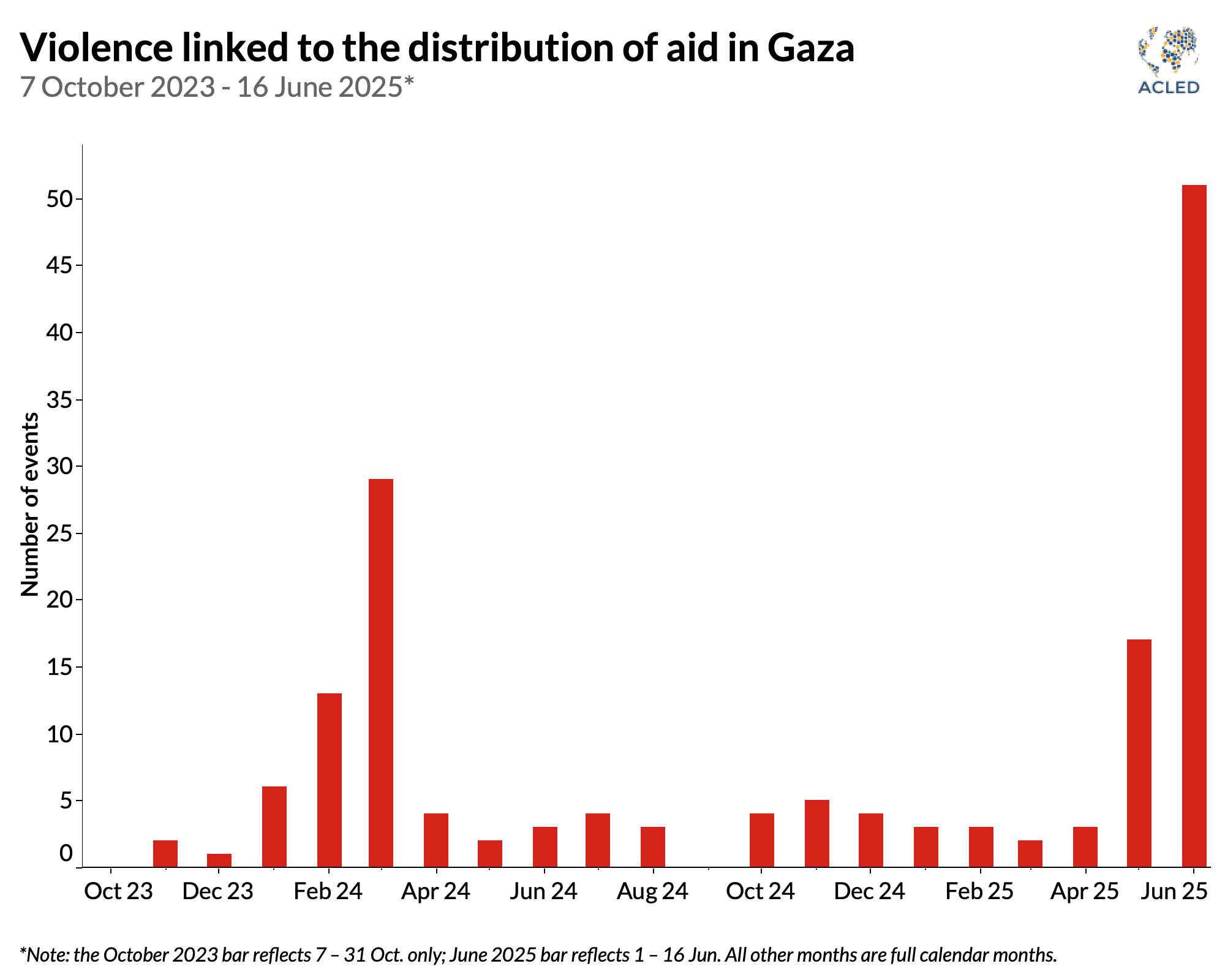
Within Gaza, the distribution of aid has become a site of violence — one that has only worsened since the beginning of the Israel-Iran conflict (see graph below). The deadliest incident so far was on 17 June, when Israeli forces fired tank shells at Palestinians waiting for flour trucks in Khan Yunis, killing over 50 people.2 In the first four days of the Israel-Iran conflict alone (between 13–16 June), ACLED records over 20 incidents where Israeli forces targeted civilians around aid distribution. Most incidents occurred near aid centers run by the US- and Israeli-backed Gaza Humanitarian Foundation (GHF), with others reported at flour distribution sites run by international organizations.
Nasser Khdour, Assistant Middle East Research Manager at ACLED (Armed Conflict Location & Event Data), said:
“The delivery of humanitarian aid has frequently led to violent and deadly incidents. From the early stages of the war, Israeli forces have targeted Hamas’ aid security committees and distribution centers to limit Hamas’ influence. Since late May and the launch of Operation Gideon’s Chariots by Israel, aid-related violence has escalated further. The control of aid distribution by Israel through the GHF has made aid-related violence more systemic, with the risk of even further escalation now that international attention is shifting away from Gaza.
“With no progress in ceasefire talks, worsening conditions on the ground in Gaza, and ongoing escalations in the West Bank, there is a danger that the unfolding Iran-Israel conflict will turn the world’s attention away from the dire situation for civilians across Palestine.”
Note to editors:
For more information, please contact the ACLED press office at [email protected].
ACLED (Armed Conflict Location & Event Data) is a global monitor that collects, analyzes, and maps data on conflict and protest. ACLED provides detailed information to help identify, understand, and track patterns and trends in conflict and crisis situations around the world.