
Report
The Resurgence of Armed Groups in the West Bank and Their Connections to Gaza
Analysis of the resurgence of Palestinian armed groups in the West Bank and their connections with Gaza.

14 December 2023
In an unprecedented surprise attack, Hamas launched a large aerial and ground operation from the Gaza Strip into Israel on 7 October, killing over 1,2001 Israelis and capturing over 200 soldiers and civilians. The Israel Defence Forces (IDF) vowed to use all means to destroy Hamas, starting a scorched-earth military campaign that has killed thousands of civilians in less than two months. The scale of Hamas’s operation sent a shockwave across the world, as Israel’s intelligence failed to detect and avert the attack. Before 7 October, a period of relative calm had prevailed in the Gaza Strip since the last outbreak of violence in May 2021. In fact, many pundits believed that Hamas — presiding over the lives of two million Palestinians as the de facto governing body in the Gaza Strip — was not ready for another full-scale conflict, and was satisfied with Israel’s economic incentives.2
Meanwhile, violence was mounting in the West Bank for over a year. Between October 2022 and September 2023, political violence in the West Bank was up by 50% compared to the year prior as a result of a steady increase in settler violence, stepped-up IDF operations, and, importantly, the reemergence of Palestinian armed groups after over one and a half decades. Since Hamas ousted the Palestinian Authority (PA) from the Gaza Strip in 2007, relegating the PA to the West Bank, patterns of violence in the two Palestinian regions have rarely followed the same trajectory. An imminent danger of spillover of violence from the West Bank into Gaza was, therefore, not immediately recognized. However, the makeup of the Palestinian armed groups that drove much of the violence in the West Bank since 2022 was already pointing to an increasing interconnectedness between the West Bank and Gaza Strip.
To assess this link, this study examines the activity of Palestinian militant groups in the West Bank in the year before the outbreak of the most recent conflict between Israel and Hamas in Gaza. Over 20 distinct armed groups engaged in more than 500 incidents of violence against Israel’s security forces and settlers during this period. ACLED classifies these armed groups under four categories: Palestinian Islamic Jihad (PIJ), Hamas, Al-Aqsa Martyrs Brigades (AAMB), and their respective affiliates, in addition to the independent Lions’ Den. A closer look at the activity of these armed groups indicates that Gaza-based militant groups PIJ and Hamas played a significant role in the deterioration of security in the West Bank through direct engagement in violence, supporting the establishment of new local armed groups, and helping to arm other factions, including Fatah-affiliated militants.
Given this escalation, Israel’s security establishment concentrated its focus on the West Bank, seemingly diverting intelligence and security resources from the border with the Gaza Strip. This gave Gazan militants an operational opportunity to launch their surprise attack. As Israel now continues to intensify its operation in Gaza, it is also faced with significant security challenges on the other conflict front in the West Bank. Furthermore, the proliferation of armed groups in the West Bank will continue to pose a challenge to a weakened PA’s ability to rule the West Bank, and will complicate any international efforts to push for the reinstatement of the PA’s control over the Gaza Strip in the short term.
Turmoil in the West Bank and the Proliferation of Armed Groups
The Palestinian national movement has historically involved diverse political and ideological factions, including secular nationalist, Marxist-Leninist, Pan-Arabist, and Islamist tendencies.3 While various Palestinian armed groups historically embraced violence against Israel in pursuit of sovereignty, 11 factions operating under the umbrella of the Palestine Liberation Organization (PLO) and the leadership of Fatah denounced armed resistance and signed the Oslo Peace Accords with Israel in the 1990s.4 Although during the Second Intifada, some groups associated with the PLO – including the Fatah-affiliated AAMB – engaged yet again in militant activities, they largely refrained from armed resistance after they were absorbed into the security apparatus of the PA following Mahmud Abbas succeeding Yasser Arafat at the helm of the PA in 2005.
In contrast, armed groups operating outside the umbrella of the PLO, above all Hamas and PIJ, continued to oppose negotiations with Israel and undertake armed resistance. Against the backdrop of the conflict between Hamas and Fatah, which led to a de facto separation of the Palestinian territories in 2007, Gaza-based militants led by Hamas fought several rounds of war with Israel. Despite these tensions, militant activity largely spared the PA-administered West Bank in the following years, amid stringent controls by both the PA and Israel’s security forces. ACLED records only around two dozen events of political violence directly linked to named armed groups in the West Bank between 2016 — when ACLED coverage of Palestine begins — and 2021.
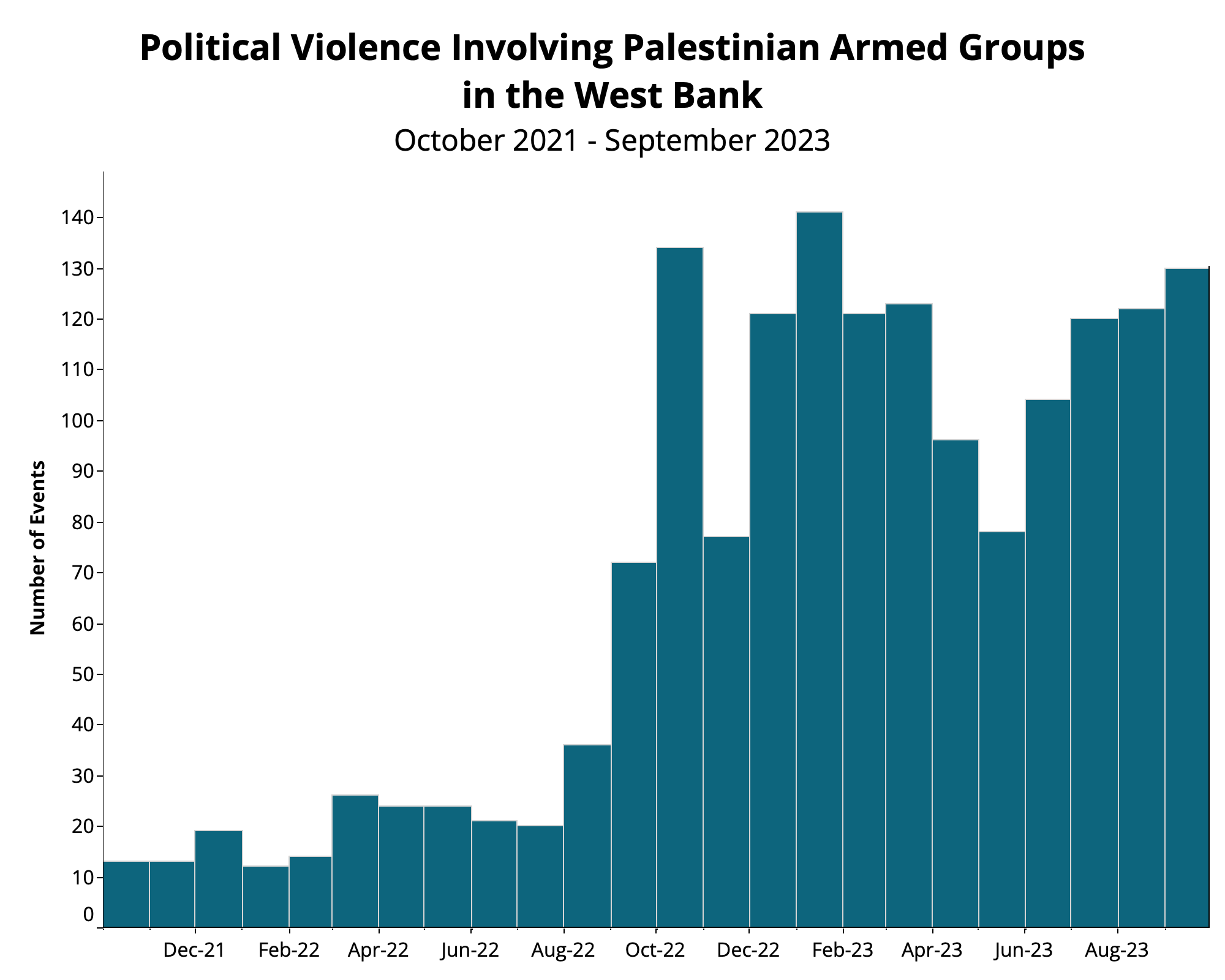
With Israel continuing to further its occupation and the de facto annexation of the West Bank,5 the prospects of a two-state solution have increasingly faded, leading to disillusionment among many Palestinian youths. Against this backdrop, multiple factors have contributed to the growth of armed groups and their expanded activity in the West Bank: the weaknesses of the PA, increasing settler violence, and forceful security measures by Israel, particularly Operation Break the Wave, which the IDF launched in response to a string of deadly attacks by Palestinian gunmen in 2022.
The weakness of the PA in governing towns and refugee camps has been an important factor that has enabled the re-emergence of armed groups’ activity in the West Bank. Failing to promote a realistic path to statehood, along with rampant corruption and the inability to effectively deliver public services, has pushed the PA into a legitimacy crisis, further compounded by an uncertain succession to aging leader Abbas and internal fragmentation.6 Israel has contributed to this crisis by following a strategy of keeping the PA alive to ensure the continuation of the security coordination but weakened by withholding tax revenues, for example.7 This is while Israel, despite its adversarial relationship with Hamas, made several concessions to the PA’s arch-rival, including facilitating the entry of Qatari funds into the Gaza Strip,8 permitting Gazans to work in Israel,9 and engaging in negotiations with Hamas regarding natural gas extraction near Gaza’s offshore areas.10 Unable to protect people in the West Bank from settler violence and the heavy-handed approach by Israel’s security forces, the PA has increasingly lost legitimacy in the eyes of the public. Its security forces were widely seen as lacking the weight and credibility to impose order in many areas of the West Bank, thus leaving a power vacuum that other armed groups have attempted to fill.
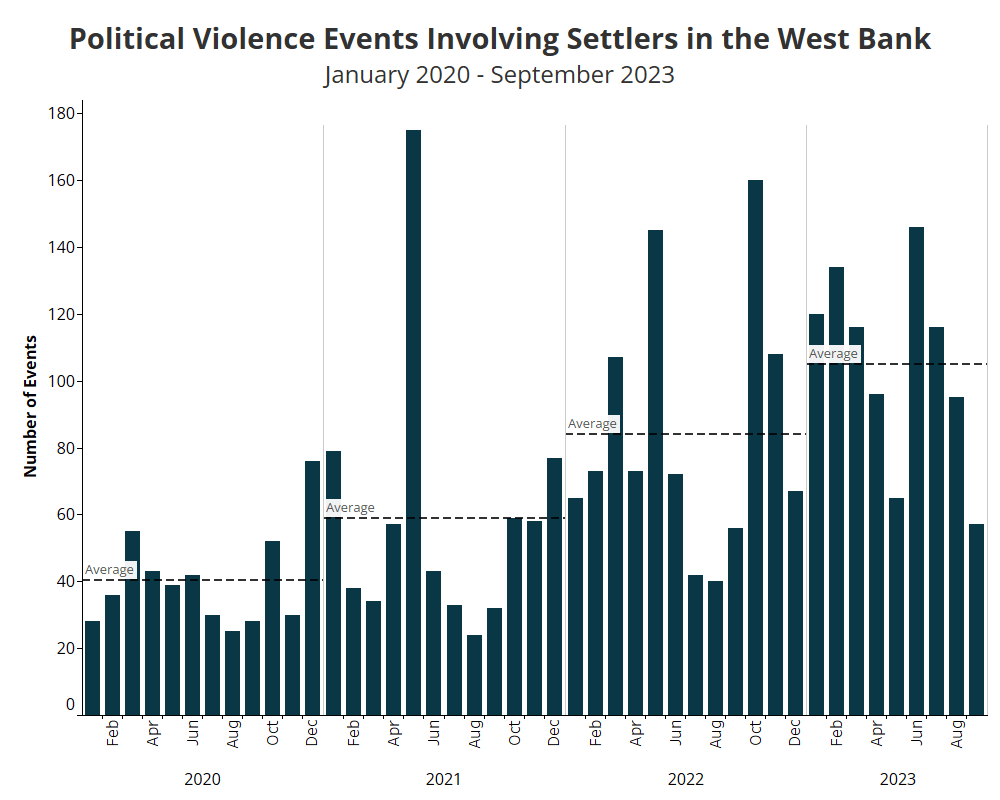
The expansion of settlements, accompanied by a steady rise in settler violence, has been another important factor that has contributed to the resurgence of armed activity in the West Bank. While in 2020 ACLED records a monthly average of 40 events involving settler violence in the West Bank, this figure increases exponentially from 2021, leading to a monthly average of 105 events as of September 2023 (see graph below). Not only has the uptick in settler violence directly preceded increases in armed group activity, particularly in areas of heightened settler activity like Nablus (discussed further in the Lions’ Den section below), but it has also led to increased popular support for armed resistance among Palestinians in the West Bank. An opinion poll in December 2022 suggested that 65% of Palestinians in the West Bank supported the formation of armed groups independent from the PA.11
Finally, the IDF launch of Operation Break the Wave in March 2022 in response to a string of attacks that killed 19 people in Israel exacerbated frictions, leading to increased violent interactions with young Palestinians. The IDF significantly increased its presence in the West Bank as part of the operation, with troop numbers doubling by October 2022.12 Between March 2022 and September 2023, the IDF carried out more than 2,000 raids, with at least 115 incidents turning deadly and resulting in over 210 reported fatalities. Many of the new armed groups in the West Bank emerged locally to act against the IDF during these arrest raids.
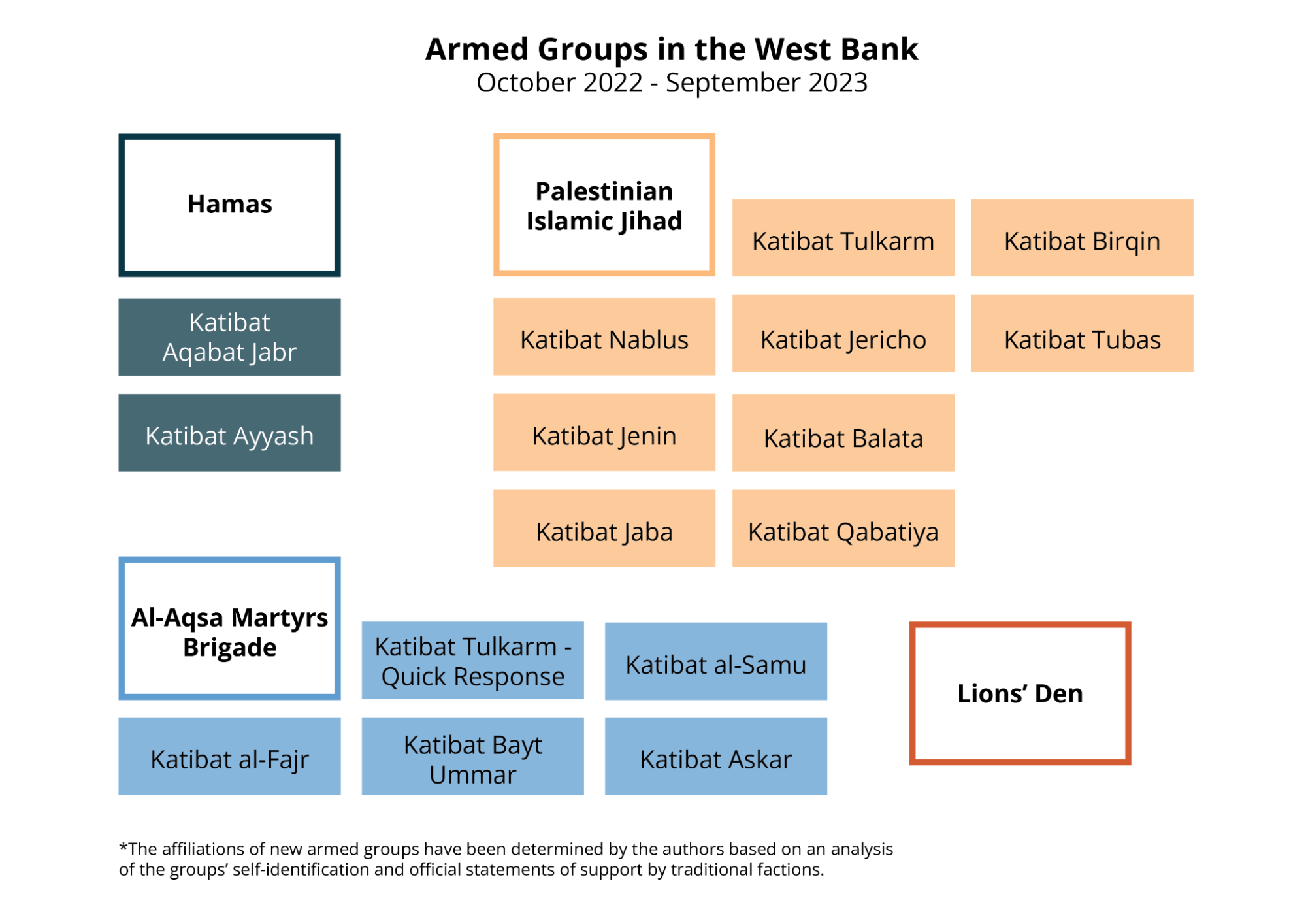
In this context, the number of active armed groups in the West Bank significantly increased between October 2022 and September 2023. During this period, ACLED records 23 active armed groups in the West Bank involved in over 500 violent events. Given that many additional armed actions remain unclaimed, it is possible that these groups have been involved in more violence but did not claim responsibility to evade the extensive PA’s and Israel’s intelligence measures.13 Furthermore, unaffiliated individuals and other armed groups may operate clandestinely in the region. The majority of armed groups in the West Bank14 can be broadly linked to PIJ, the AAMB, and Hamas, while the Lions’ Den is a self-proclaimed independent group (see chart below).15
Jenin governorate has been at the heart of escalating violence in the West Bank during the last year. Jenin was the stronghold of PIJ in the West Bank already during the Second Intifada — where most PIJ suicide bombers originated — with the Jenin refugee camp becoming a ‘safe haven’ for wanted militant leaders during this period.16 The groups’ armed activity once more has been reinvigorated over the past two years at Jenin refugee camp, where PIJ-affiliated Katibat Jenin has emerged as one of the largest and foremost armed groups. The katibat (brigade in Arabic) is believed to have its roots in a small cell established by PIJ militant Jamil al-Amuri to carry out shooting attacks on Israeli soldiers on the heels of the May 2021 outbreak of violence across Palestinian territories and Israel.17 While al-Amuri was killed in an IDF raid in June 2021, the group later rose to prominence providing protection for militants in Jenin camp who had escaped from Gilboa prison in Israel in September 2021.18 Katibat Jenin has since increasingly coordinated with other groups active in the governorate, further eroding the authority of the Palestinian security forces in the area,19 and posing a significant challenge to Israel’s army. The IDF has referred to the Jenin refugee camp as the “command center” for the new wave of Palestinian militants20 and has carried out some of its most forceful operations in the West Bank against the group over the past year.
Nablus has been another hotbed of armed activity in the West Bank, where the local PIJ Katibat Nablus has been highly active along with some other groups, including the Lions’ Den. Katibat Nablus was established in May 202221 after IDF shot a 16-year-old Palestinian in the head near the Tomb of Joseph in Nablus, an important site for Judaism. Frequent visits by more settlers to the tomb — perceived by Palestinians as provocation22 — often sparks confrontation as hundreds of Israel’s military forces enter the city of Nablus in advance of such visits to secure the area. Furthermore, Nablus is home to 24 Israeli settlements and illegal outposts, the majority of which were created for ideological or religious reasons.23 This governorate is home to some of the most radical settlements, including Yitzhar, Itamar, and Bracha, and settler violence is endemic in the area (see maps below). The city of Nablus is the only area of the governorate that is part of Area A of the West Bank, under the control of the PA, with security in other towns and villages under Israeli control. Katibat Nablus and other armed groups in the area — including the Lions’ Den — have increasingly taken matters into their own hands, engaging in violence against Israel’s security forces in both offensive and defensive postures, and also occasionally targeting settlers.
Based in Tulkarm governorate, Katibat Tulkarm is the third most active among PIJ-affiliated groups. The group emerged in late 2022 at Nur al-Shams refugee camp and has since been active in neighboring Tulkarm refugee camp. The April 2022 killing of a Nur al-Shams resident — who had joined Katibat Jenin — is believed to have spurred the formation of Katibat Tulkarm by local youths.24 These militants patrol the streets and alleys of both camps during the day, barricade their entrances with iron barriers, set up night watches, and engage with Israeli soldiers during raids.25 The group has also attacked Israeli military checkpoints in the area and occasionally fired shots at nearby settlements, without inflicting casualties.
Visuals in this report were produced by Ana Marco.
Footnotes
- 1
- 2
Eric Leskly, ‘End of Illusions in a Never Again War,’ Times of Israel, 1 November 2023
- 3
- 4
Martin S. Indyk, ‘Is Yasser Arafat a Credible Partner for Peace?’ Brookings, 6 June 2002
- 5
- 6
Tariq Dana, ‘Mahmoud Abbas and the PA’s succession dilemma,’ The New Arab, 12 August 2021
- 7
- 8
- 9
Hagar Shezaf, ‘Israel Expands Number of Work Permits for Gazans,’ Times of Israel, 22 September 2022
- 10
- 11
Palestinian Center for Policy and Survey Research, ‘Public Opinion Poll No (86),’ 10 December 2022
- 12
- 13
- 14
Other groups engaged in a small number of events include Mujahidin Brigades, Popular Front for the Liberation of Palestine, and al-Nassier Salah al-Din Brigades.
- 15
The affiliations of new armed groups with established traditional factions, notably Hamas, PIJ, and AAMB, have been determined and classified through an analysis of the groups’ self-identifications on platforms like Telegram channels. These digital platforms have provided explicit indications of the armed groups’ alignment with the traditional factions. Furthermore, the adoption of specific logos and the use of distinctive headbands by fighters within these armed groups have served as visual cues demonstrating their association with the traditional factions. Additionally, it has been observed that when members of these armed groups have been killed, they have often been draped with flags and symbols representing the traditional political groups, thereby solidifying their recognition as members of these groups. Lastly, there have been statements made by senior officials from traditional factions to confirm their support and relationships with new groups.
- 16
Erik Skare, ‘A History of Palestinian Islamic,’ Cambridge University Press, 2021, p. 171" data-value="35">
- 17
BBC, ‘Palestinian security officers killed during Israeli raid in West Bank’, 10 June 2021" data-value="36">
- 18
Jahad Barakat, ‘Factors that generated the “Jenin Brigade”… a new generation of resistance fighters in the West Bank,’ The New Arab, 30 September 2022" data-value="37">
- 19
Middle East Monitor, ‘Blinken put pressure on Abbas to accept US security plan for Jenin and Nablus,’Middle East Monitor, 2 February 2023" data-value="38">
- 20
Haaretz, ‘Explained: What’s Happening in the Palestinian City of Jenin, and Why Is Israel Targeting It?’ 3 July 2023" data-value="39">
- 21
Ahmad Melhem, ‘Palestinian Islamic Jihad ramps up capabilities in West Bank,’ Al-Monitor, 1 June 2022" data-value="40">
- 22
Agence France-Presse, ‘Palestinian Ministry Says Israeli Forces Killed Palestinian in West Bank,’ 20 July 2023" data-value="41">
- 23
Peace Now, ‘Settlements List,’ 2023" data-value="42">
- 24
Leila Warah, ‘West Bank: Armed Palestinian resistance building in refugee camps over Israeli raids,’ Middle East Eye, 24 June 2023" data-value="43">
- 25
Qais Omar Darwesh Omar and Iyad Nabolsi, ‘ Israel’s rising attacks on Nour Shams refugee camp spark concerns among Palestinians,’ Anadolu Agency, 8 August 2023" data-value="44">
Related content


