
Report
The Rwanda Defence Force (RDF) operations abroad signal a shift in Rwanda's regional standing
Explores the roles and operations of the Rwanda Defence Force in regional conflicts and their geopolitical significance.

Watch the recorded webinar examining Rwanda’s security interventions, with a special focus on operations in Mozambique and the DRC.
Amidst mounting criticism against the failures of United Nations peacekeeping and Western military involvement, an increasing number of African governments across the continent have demanded the withdrawal of former military partners.1 These emerging security gaps have been increasingly filled by new armed actors and forms of cooperation, including private military companies, local self-defense groups, and regional partnerships. Having long contributed to multilateral peacekeeping missions, Rwanda has positioned itself as an alternative security partner, sending bilateral missions across the continent.2 The Rwanda Defence Force (RDF) began engaging in further bilateral operations in late 2020 when RDF soldiers and special forces deployed to the Central African Republic to counter a rebel offensive. That engagement expanded in 2021 when Rwanda deployed forces to Mozambique in the face of the rising Islamist insurgency in northern Cabo Delgado province.3
While Rwanda has increased involvement in regional security alongside host governments, since 2022 the bulk of its regional interventionism has shifted toward supporting the March 23 (M23) rebel movement in fighting Congolese military forces (FARDC) and allied militias in the Democratic Republic of Congo (see map below). Although Rwandan troops have carried out low levels of civilian targeting across the continent as a proportion of their total operations in multilateral and bilateral operations, the DRC case shows the increased risks to civilians due to Rwanda’s rising use of artillery shelling and equipping of proxy fighters — a growing concern in the Great Lakes Region.4
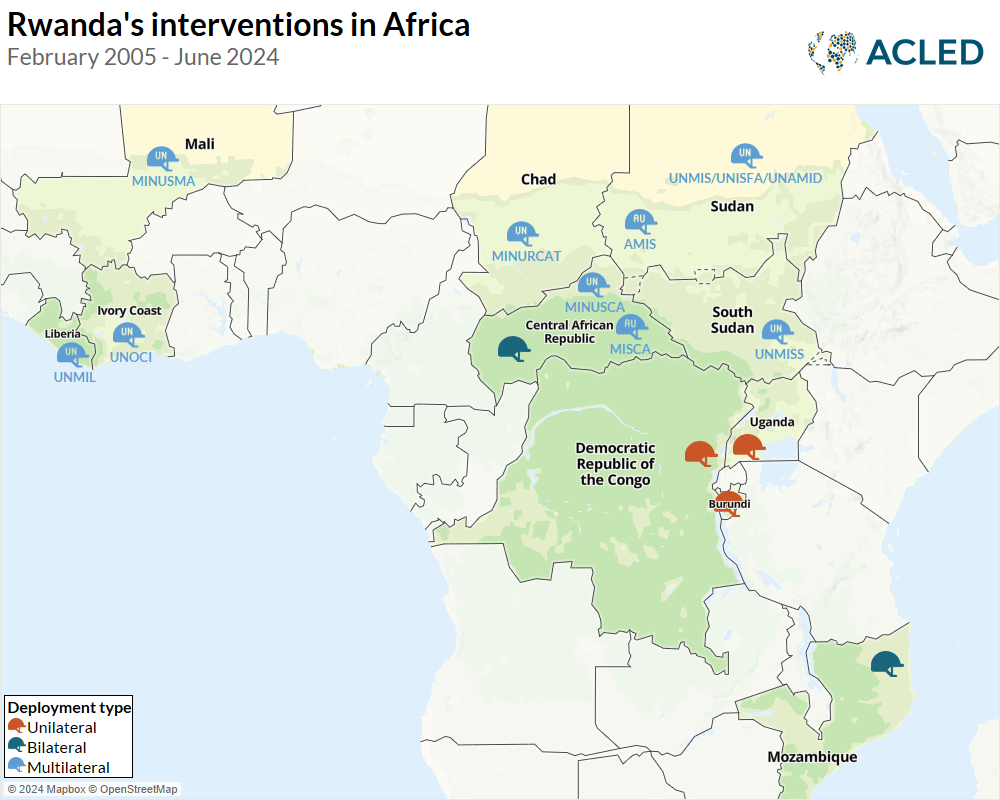
While several other reports consider Rwanda’s involvement in multilateral operations, this piece examines how Rwanda’s foreign military operations have changed since 2020, drawing on case studies from bilateral operations in Mozambique and unilateral deployment into DRC in support of the M23 rebel group. The case of Mozambique illustrates the RDF’s capacity to support counter-offensives against competing armed groups and suppress levels of violence, but with limited ability to curb civilian targeting from other armed groups, as was the case in CAR. The RDF involvement in Mozambique also illustrates the forms of Rwandan bilateral operations in Africa, including engagement in security, economic activity, and politics. Like its bilateral and multilateral deployments, the RDF’s presence in the DRC provides Kigali with economic benefits obtained by controlling strategic roadways and mining sites.
The growth of Rwandan foreign security engagement
After Rwanda deployed forces into neighboring Zaire — now the DRC — during the Congo Wars from 1996 to a blurry conclusion in 2002, Rwanda turned toward contributing troops and additional personnel for multilateral deployment. Since 2004, Rwanda has increased its deployment to multilateral peacekeeping missions,5 with growing numbers of troops deployed to UN and African Union missions. Rwanda’s foreign security deployments also grew to include bilateral missions in 2020, building international legitimacy as a cooperative partner for multinational security operations. The deployment and deeper integration into peacekeeping and bilateral missions spanning the continent provide political leverage for Kigali, economic resources, and strategic training for Rwandan personnel.6 Further, Rwanda funds a substantial portion of the national defense budget through contributions from UN peacekeeping missions. Bilateral missions in CAR and Mozambique also provide considerable commercial opportunities for Rwandan firms, some of which are reported to have links to President Paul Kagame’s ruling Rwandan Patriotic Front (RPF).7 For the past 30 years, several large firms owned fully or partly by the ruling RPF developed under party management and expanded into many sectors of the economy.8
The growth of unilateral operations and indirect support for the M23 has generated tensions between Rwanda and several Western countries — often the same countries supportive of and reliant upon Rwandan peacekeeping contributions.
Alongside bilateral and multilateral operations, Rwanda deployed troops to the DRC and has increased its military engagement amid the latest M23 offensive. The growth of unilateral operations and indirect support for the M23 has generated tensions between Rwanda and several Western countries — often the same countries supportive of and reliant upon Rwandan peacekeeping contributions. The Rwandan government now balances the criticism and threats for its involvement in the DRC with its contributions to peacekeeping operations, with mixed reception of its bilateral operations. In several instances, Kigali used its position as a significant troop contributor to counter foreign criticism, threatening to withdraw peacekeepers from multilateral missions.9
Spokespersons for Kigali have yet to admit direct military involvement or support for the M23. Instead, Kagame and other Rwandan political leaders increasingly deflect critics’ questions by responding with rhetorical questions that allude to reasons Rwanda’s involvement in the DRC would be warranted. They cite threats to domestic and regional security, including continued operations of the Democratic Forces for the Liberation of Rwanda (FDLR) and their collaboration with FARDC, military buildup in Congo, Congolese political rhetoric to invade Rwanda, and violence against Congolese Tutsi.10 Kagame and other Rwandan officials have also noted the colonial construction of the country’s borders, remarking that this part of eastern DRC was formerly part of Rwanda.11
For those more critical of Rwanda’s actions, the threats of the FDLR claimed by Kigali are simply a false pretext for Rwanda to continue exerting its economic and political influence in eastern DRC.12 While various studies have long signaled the smuggling of resources from the DRC into Rwanda and other regional neighbors,13 Congolese officials increasingly point to these resource interests and Kigali’s desire to annex part of eastern DRC as motivation for Rwanda’s renewed involvement.14 The replacement of local government officials with M23 militants and supporters throughout areas of North Kivu also provides evidence of Rwandan and M23 interests in local political power.15
Still, increasing sources of drone footage and eyewitness photography of Rwandan soldiers and heavy military equipment in the DRC make denying Rwandan military presence more difficult.16 According to recent estimates, Rwanda deployed around 3,000 soldiers to the DRC — primarily operating alongside the M23 — with further provision of training and equipment for rebel fighters.17
Visuals produced by Christian Jaffe.
Footnotes
- 1
Amongst numerous examples, French direct military operations in Africa ceased in 2022; East African Community (EAC) peacekeepers were withdrawn from the DRC in 2023; and UN peacekeeping operations withdrew from Mali and are in the process of leaving the DRC.
- 2Federico Donelli, 'Rwanda’s New Military Diplomacy,’ Institut français des relations internationales, N.31, 2022
- 3Brendon Cannon and Federico Donelli, ‘Rwanda’s Military Deployments in Sub-Saharan Africa: A Neoclassical Realist Account,’ The International Spectator, 24 October 2022
- 4International Crisis Group, 'A Dangerous Escalation in the Great Lakes,' 27 January 2023; UN Security Council, 'Increased Fighting in Democratic Republic of Congo Exacerbating Security Woes Threatening Regional Conflagration, Special Envoy Warns Security Council,' SC/15677, 24 April 2024
- 5UN Peacekeeping, 'Peacekeeping operations,' 31 March 2024; Marco Jowell, 'Contributor Profile: Rwanda,' School of Oriental and African Studies and Africa Research Group, 22 April 2018
- 6Nina Wilén, 'From “Peacekept” to Peacekeeper: Seeking International Status by Narrating New Identities,' Journal of Global Security Studies, March 2022; Marco Jowell, 'Contributor Profile: Rwanda,' School of Oriental and African Studies and Africa Research Group, 22 April 2018
- 7Nina Wilén, 'A Hybrid Peace through Locally Owned and Externally Financed ssr–ddr in Rwanda?,' Third World Quarterly, 5 July 2012
- 8Nilgün Gökgür, 'Rwanda’s ruling party-owned enterprises: Do they enhance or impede development?,' Universiteit Antwerpen, Institute of Development Policy Discussion Papers, March 2012
- 9FedericoDonelli, 'Rwanda’s New Military Diplomacy,' IFRI, N.31, 2022
- 10
See, for example, Rwanda Ministry of Foreign Affairs and International Cooperation, 'Rwanda Clarifies Security Posture,' 18 February 2024; Michela Wrong, 'Kagame’s Revenge: Why Rwanda’s Leader Is Sowing Chaos in Congo,' Foreign Affairs, 13 April 2023; Charles Onyango-Obbo, 'Kagame: DRC has crossed red line, war won’t be in Rwanda,' The East African, 26 February 2023; Musinguzi Blanshe, 'Rwanda & DRC accuse each other of using rebel groups to their advantage,' The Africa Report, 10 June 2022; RwandaTV, 'President Kagame discusses Tshisekedi’s threats, M23 & the DRC, Burundi & FDLR alliance,' 25 March 2024
- 11RFI, 'La RDC réagit aux déclarations du président rwandais Paul Kagame sur les frontières congolaises,' 17 April 2023
- 12Wendy Bashi, '‘‘Les FDLR ont toujours été un faux vrai prétexte pour le Rwanda pour continuer à considérer l’Est du Congo comme sa zone d’influence” (Bob Kabamba),' Deutsche Welle, 14 February 2022
- 13UNSC, 'Midterm report of the Group of Experts on the Democratic Republic of the Congo,' S/2019/974, 20 December 2019, Section III; IPIS, ASSODIP, and DIIS, 'Le M23: Enjeux, motivations, perceptions et impacts locaux,' April 2024
- 14Tom Wilson and Andres Schipani, 'DRC says Rwandan mineral smuggling costs it almost $1bn a year,' Financial Times, 21 March 2023; IPIS, ASSODIP, and DIIS, 'Le M23: Enjeux, motivations, perceptions et impacts locaux,' April 2024, pp. 5
- 15IPIS, ASSODIP, and DIIS, 'Le M23: Enjeux, motivations, perceptions et impacts locaux,' April 2024
- 16UNSC, 'Midterm report of the Group of Experts on the Democratic Republic of the Congo,' S/2023/990, 30 December 2023; Cécile Andrzejewski, 'Soldiers fallen in silence: Kagame’s unacknowledged war in the Democratic Republic of the Congo,' Forbidden Stories, 28 May 2024
- 17Simon Marks and Neil Munshi, 'Rwandan Meddling Is Deepening Congo’s Deadly Conflict,' Bloomberg, 19 April 2024; UNSC, 'Midterm report of the Group of Experts on the Democratic Republic of the Congo,' S/2023/990, 30 December 2023


